-
 info
info -
info
The video presents a close up view of one of the objects from Albina's installation "I want to be as high as dolphin on a puffer fish" (2024). It was presented during the graduation show at the Royal Academy of Fine Arts (KABK). Here the artist is interacting with one of the sculptures from "Bivalve's Lullaby" series.
-
 info
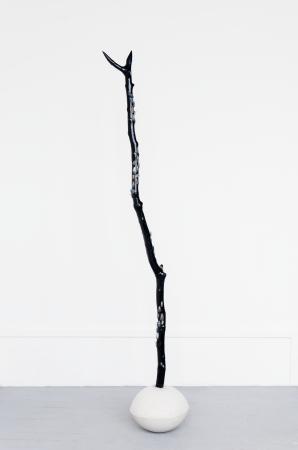
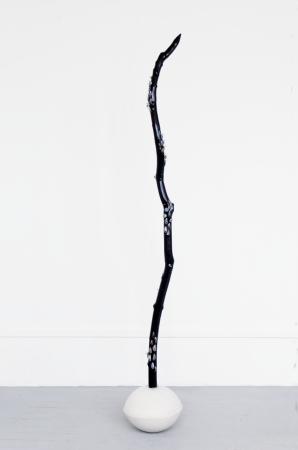
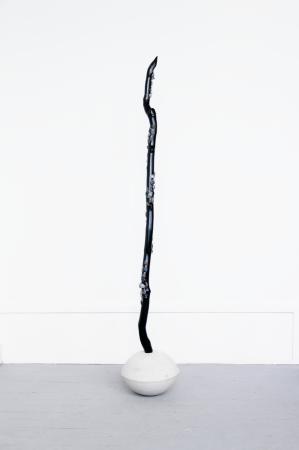
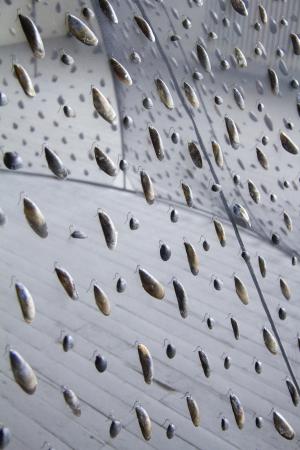
infoBivalve’s lullaby is a series of sound-producing sculptures responsive to touch. Presumably covered in petroleum, a deep-black, glossy branch reminiscent of driftwood is an outcome of visual speculations on the possible futures of the marine habitat—one that struggles with oil spills, plastic debris, collapse of ecosystems, accumulation of pesticides and herbicides, heavy metals, and much more. In the current state of ecological crisis, when we have altered and affected such a complex system with significant impacts on marine ecosystems, biodiversity, and directly dependant human communities, it is ready to reciprocate, with steadily rising sea levels. The imagery of a glossy, deep-black driftwood covered with dark-colored seashells becomes a response to speculations and assumptions about the possible futures of a marine habitat. Swinging back and forth, the sculptures resemble rattles to calm your climate anxiety.
-
 info
infoBivalve’s lullaby is a series of sound-producing sculptures responsive to touch. Presumably covered in petroleum, a deep-black, glossy branch reminiscent of driftwood is an outcome of visual speculations on the possible futures of the marine habitat—one that struggles with oil spills, plastic debris, collapse of ecosystems, accumulation of pesticides and herbicides, heavy metals, and much more. In the current state of ecological crisis, when we have altered and affected such a complex system with significant impacts on marine ecosystems, biodiversity, and directly dependant human communities, it is ready to reciprocate, with steadily rising sea levels. The imagery of a glossy, deep-black driftwood covered with dark-colored seashells becomes a response to speculations and assumptions about the possible futures of a marine habitat. Swinging back and forth, the sculptures resemble rattles to calm your climate anxiety.
-
 info
infoBivalve’s lullaby is a series of sound-producing sculptures responsive to touch. Presumably covered in petroleum, a deep-black, glossy branch reminiscent of driftwood is an outcome of visual speculations on the possible futures of the marine habitat—one that struggles with oil spills, plastic debris, collapse of ecosystems, accumulation of pesticides and herbicides, heavy metals, and much more. In the current state of ecological crisis, when we have altered and affected such a complex system with significant impacts on marine ecosystems, biodiversity, and directly dependant human communities, it is ready to reciprocate, with steadily rising sea levels. The imagery of a glossy, deep-black driftwood covered with dark-colored seashells becomes a response to speculations and assumptions about the possible futures of a marine habitat. Swinging back and forth, the sculptures resemble rattles to calm your climate anxiety.
-
 info
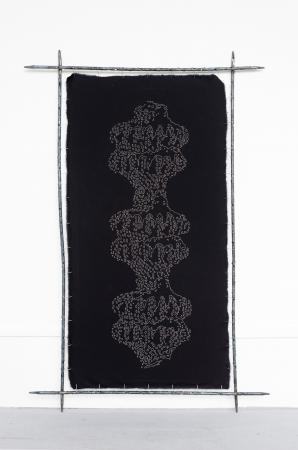
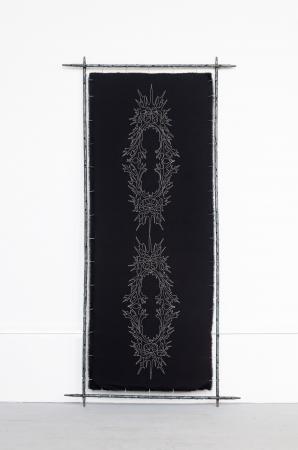
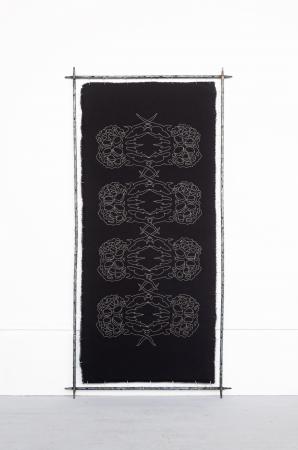
infoSeries of hand crafted embroideries Challenger’s series is a continuation of the project based on the exploration of the Northern Sea. This series of embroideries tells a story of unexpected findings, mutated organisms collected in the deep sea waters. Initially, the motifs for the embroideries are based on the illustrations documenting the voyage of the HMS Challenger. The Challenger expedition of 1872–1876 was the first scientific program to explore the deep seas on a global scale. That expedition played a major role in modern oceanography, laying the foundation of that scientific discipline. The Challenger brought up the idea of viewing the ocean as a large and complex ecosystem on which all life on Earth depends.
-
 info
infoSeries of hand crafted embroideries Challenger’s series is a continuation of the project based on the exploration of the Northern Sea. This series of embroideries tells a story of unexpected findings, mutated organisms collected in the deep sea waters. Initially, the motifs for the embroideries are based on the illustrations documenting the voyage of the HMS Challenger. The Challenger expedition of 1872–1876 was the first scientific program to explore the deep seas on a global scale. That expedition played a major role in modern oceanography, laying the foundation of that scientific discipline. The Challenger brought up the idea of viewing the ocean as a large and complex ecosystem on which all life on Earth depends.
-
 info
infoSeries of hand crafted embroideries Challenger’s series is a continuation of the project based on the exploration of the Northern Sea. This series of embroideries tells a story of unexpected findings, mutated organisms collected in the deep sea waters. Initially, the motifs for the embroideries are based on the illustrations documenting the voyage of the HMS Challenger. The Challenger expedition of 1872–1876 was the first scientific program to explore the deep seas on a global scale. That expedition played a major role in modern oceanography, laying the foundation of that scientific discipline. The Challenger brought up the idea of viewing the ocean as a large and complex ecosystem on which all life on Earth depends.
-
 info
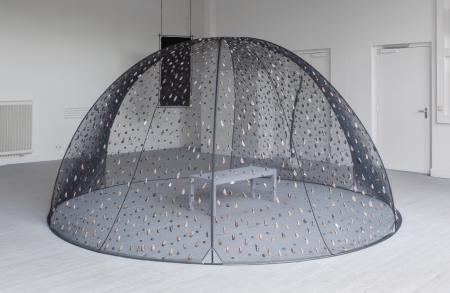
infoSpatial construction Дом (dom) - in translation from Russian means “home.” Dome is the first work made as part of the sea project. It was the most urgent object I had to build. The dome was meant to be a house, a safe space for the imaginary deep-sea creature - the main character in the suggested underwater narrative. Initially, the whole story starts from my personal phobia of open waters. Unfortunately, I am cursed to see the beauty of the sea and dive into a deep sense of melancholy at the same time. This mysterious and alluring habitat, which once was a home, I now see as hostile and profoundly sad. To change the power dynamics in my personal relationship with such natural phenomena as the sea, I built an imaginary narrative. I tell a story where, instead of being a victim, I acquire powers and become a gigantic, long-living, hunting, and unconditionally fearless deep-sea creature.
-
 info
infoSpatial construction Дом (dom) - in translation from Russian means “home.” Dome is the first work made as part of the sea project. It was the most urgent object I had to build. The dome was meant to be a house, a safe space for the imaginary deep-sea creature - the main character in the suggested underwater narrative. Initially, the whole story starts from my personal phobia of open waters. Unfortunately, I am cursed to see the beauty of the sea and dive into a deep sense of melancholy at the same time. This mysterious and alluring habitat, which once was a home, I now see as hostile and profoundly sad. To change the power dynamics in my personal relationship with such natural phenomena as the sea, I built an imaginary narrative. I tell a story where, instead of being a victim, I acquire powers and become a gigantic, long-living, hunting, and unconditionally fearless deep-sea creature.
-
 info
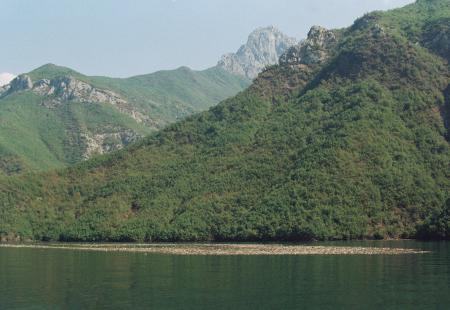
infoDocumentary pictures from the research trip to Albania in 2024 to see the ecological impact of growing tourism caused by social media promotion campaign. / Plastic island found in the Drin River - the only way for tourist to rich the starting point of the most promoted hiking rout.
-
 info
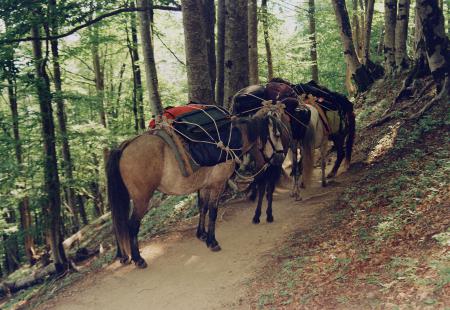
infoDocumentary pictures from the research trip to Albania in 2024 to see the ecological impact of growing tourism caused by social media promotion campaign. / Encounter with the packhorses carrying tourists’s suitcases on the hike across the mountain range between the villages Valbonё and Theth.
-
 info
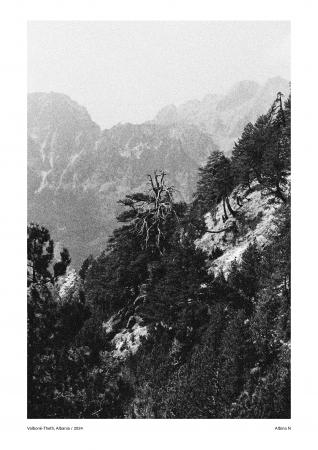
infoSeries of documentary photographs from the research trip to Albania in 2024 aimed to see the ecological impact of growing tourism caused by social media promotion campaign.
-
 info
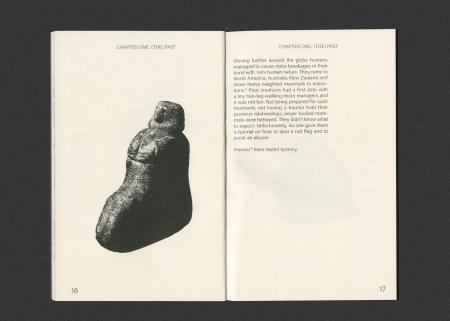
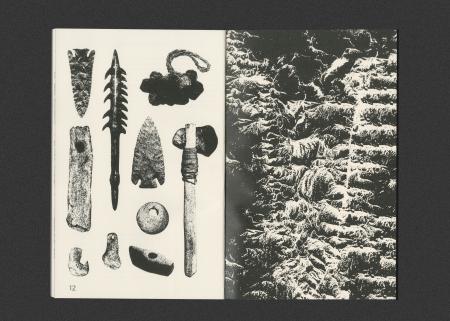
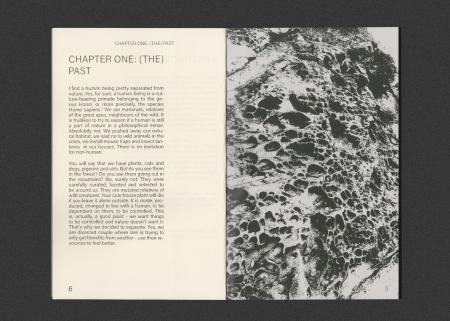
infoThe writing is an overview of development of the human-nature relationships through the prism of science, humour, and self-reflection.
-
 info
infoThe writing is an overview of development of the human-nature relationships through the prism of science, humour, and self-reflection.
-
 info
infoThe writing is an overview of development of the human-nature relationships through the prism of science, humour, and self-reflection.
-
 info
infoThe writing is an overview of development of the human-nature relationships through the prism of science, humour, and self-reflection.
-
 info
infoAn abstract poem inspired by personal experience of moving to the Netherlands and adjusting to the realities of new culture, new weather conditions, and new daily routine.
-
![How long does it take for salt to []]( "How long does it take for salt to []") info
infoSalt rocks undergo a long geological formation process which contains multiple stages. Firstly, eroded sediments sink into the water and end up on the bottom of lakes, seas and oceans. Thousands, sometimes millions, of years of deposition leads to a build up of sedimentary layers. Besides mining, there is another way of collecting salt. Harvesting from bodies of water - seas, oceans, and lakes. This process requires the excavation of pools where saltwater can be captured and evaporated by the sun and wind. The evaporation process leaves behind layers of salt crystals that can only be harvested at certain times of the year. In contrast to elements in the natural environment - such as the sun’s heat and the wind - in the artificial setting radiators, and air conditioning within the space exist. So too does the presence of the viewer affects air movement. Whilst the transformation of salt from solid to liquid, and back to solid state in the natural world usually takes a long period of time, the installation has accelerated this process to a matter of days. Just as labourers must wait for the right time of year, the change in the work requires patience to see the metamorphosis. The difference in the speed of dissolving in every object invites to navigate through space, to pay attention to the small details, and truly examine the minutiae of the change.
-
![How long does it take for salt to []]( "How long does it take for salt to []") info
infoSalt rocks undergo a long geological formation process which contains multiple stages. Firstly, eroded sediments sink into the water and end up on the bottom of lakes, seas and oceans. Thousands, sometimes millions, of years of deposition leads to a build up of sedimentary layers. Besides mining, there is another way of collecting salt. Harvesting from bodies of water - seas, oceans, and lakes. This process requires the excavation of pools where saltwater can be captured and evaporated by the sun and wind. The evaporation process leaves behind layers of salt crystals that can only be harvested at certain times of the year. In contrast to elements in the natural environment - such as the sun’s heat and the wind - in the artificial setting radiators, and air conditioning within the space exist. So too does the presence of the viewer affects air movement. Whilst the transformation of salt from solid to liquid, and back to solid state in the natural world usually takes a long period of time, the installation has accelerated this process to a matter of days. Just as labourers must wait for the right time of year, the change in the work requires patience to see the metamorphosis. The difference in the speed of dissolving in every object invites to navigate through space, to pay attention to the small details, and truly examine the minutiae of the change.
-
![How long does it take for salt to []]( "How long does it take for salt to []") info
infoSalt rocks undergo a long geological formation process which contains multiple stages. Firstly, eroded sediments sink into the water and end up on the bottom of lakes, seas and oceans. Thousands, sometimes millions, of years of deposition leads to a build up of sedimentary layers. Besides mining, there is another way of collecting salt. Harvesting from bodies of water - seas, oceans, and lakes. This process requires the excavation of pools where saltwater can be captured and evaporated by the sun and wind. The evaporation process leaves behind layers of salt crystals that can only be harvested at certain times of the year. In contrast to elements in the natural environment - such as the sun’s heat and the wind - in the artificial setting radiators, and air conditioning within the space exist. So too does the presence of the viewer affects air movement. Whilst the transformation of salt from solid to liquid, and back to solid state in the natural world usually takes a long period of time, the installation has accelerated this process to a matter of days. Just as labourers must wait for the right time of year, the change in the work requires patience to see the metamorphosis. The difference in the speed of dissolving in every object invites to navigate through space, to pay attention to the small details, and truly examine the minutiae of the change.
-
![How long does it take for salt to []]( "How long does it take for salt to []") info
infoSalt rocks undergo a long geological formation process which contains multiple stages. Firstly, eroded sediments sink into the water and end up on the bottom of lakes, seas and oceans. Thousands, sometimes millions, of years of deposition leads to a build up of sedimentary layers. Besides mining, there is another way of collecting salt. Harvesting from bodies of water - seas, oceans, and lakes. This process requires the excavation of pools where saltwater can be captured and evaporated by the sun and wind. The evaporation process leaves behind layers of salt crystals that can only be harvested at certain times of the year. In contrast to elements in the natural environment - such as the sun’s heat and the wind - in the artificial setting radiators, and air conditioning within the space exist. So too does the presence of the viewer affects air movement. Whilst the transformation of salt from solid to liquid, and back to solid state in the natural world usually takes a long period of time, the installation has accelerated this process to a matter of days. Just as labourers must wait for the right time of year, the change in the work requires patience to see the metamorphosis. The difference in the speed of dissolving in every object invites to navigate through space, to pay attention to the small details, and truly examine the minutiae of the change.
-
![How long does it take for salt to []]( "How long does it take for salt to []") info
infoSalt rocks undergo a long geological formation process which contains multiple stages. Firstly, eroded sediments sink into the water and end up on the bottom of lakes, seas and oceans. Thousands, sometimes millions, of years of deposition leads to a build up of sedimentary layers. Besides mining, there is another way of collecting salt. Harvesting from bodies of water - seas, oceans, and lakes. This process requires the excavation of pools where saltwater can be captured and evaporated by the sun and wind. The evaporation process leaves behind layers of salt crystals that can only be harvested at certain times of the year. In contrast to elements in the natural environment - such as the sun’s heat and the wind - in the artificial setting radiators, and air conditioning within the space exist. So too does the presence of the viewer affects air movement. Whilst the transformation of salt from solid to liquid, and back to solid state in the natural world usually takes a long period of time, the installation has accelerated this process to a matter of days. Just as labourers must wait for the right time of year, the change in the work requires patience to see the metamorphosis. The difference in the speed of dissolving in every object invites to navigate through space, to pay attention to the small details, and truly examine the minutiae of the change.

![How long does it take for salt to []](https://api.mijn.stroom.nl/upload/thumb/6fcce9f9ffa72eb97045983efebc3db6.jpg "How long does it take for salt to []")
![How long does it take for salt to []](https://api.mijn.stroom.nl/upload/thumb/c5a15f127f59152101de2df90fbb8371.jpg "How long does it take for salt to []")
![How long does it take for salt to []](https://api.mijn.stroom.nl/upload/thumb/9195338b79ad6c6283e0c8e6c0c01e63.jpg "How long does it take for salt to []")
![How long does it take for salt to []](https://api.mijn.stroom.nl/upload/thumb/a22897d1fc18b17bf77dd8932dc6ab98.jpg "How long does it take for salt to []")
![How long does it take for salt to []](https://api.mijn.stroom.nl/upload/thumb/210c0878c94f1e96e38188c194fb81c0.jpg "How long does it take for salt to []")
Websites
Personal portfolio website
albinan.comSocial media
Curriculum vitae
Education
-
2022 - 2024Bachelor of Fine Arts Den Haag, Koninklijke Academie van Beeldende Kunsten diploma
-
2019 - 2022BA (Hons) Fine Arts Moscow, British Higher School of Art & Design
exhibitions
-
2025OYO 8 The Haagse Kunstkring, The Hague The Hague, Netherlands Group
-
2025The New Current 2025 De Kaai Rotterdam, Netherlands www.thenewcurrent.org/25albina-nezhemedinova Group
-
2025
-
2024Castaway Sexyland Amsterdam, Netherlands Group
-
2024I want to be as high as dolphin on a puffer fish KABK The Hague, Netherlands graduation.kabk.nl/2024/albina-n Solo
-
2024Changing Our Story Billy Town The Hague, Netherlands changingourstory.eu/art-exhibit-of-the-project-changing-our-story-hague/ Group
-
2024
-
2024Castaway Sexyland Amsterdam, Netherlands Group
-
2023Everything That Grows Underground West / Pulchri The Hague, Netherlands www.pulchri.nl/nl/tentoonstellingen/everything-that-grows-underground-kabk-fine-arts-exhibition/ Group
-
2021Soundhood BHSAD Moscow, Russian Federation Duo
-
2021
-
2021
-
2020Foundations: 100 years after VKHUTEMAS blip blip blip Moscow, Russian Federation blipblipblip.co/foundations-100-years-after-vkhutemas Group
Publications
-
2024Goedemorgen Monograph Bog Bodies Press Albina N Eindhoven, Netherlands bogbodiespress.com/mnemotope-006 Poem featuring in the magazine.
-
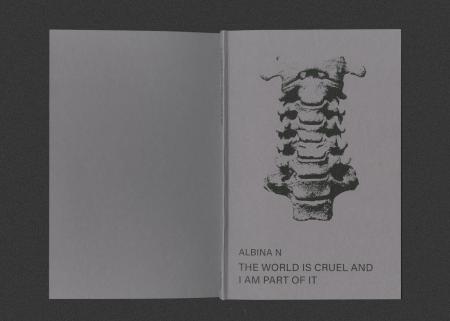
2024The World Is Cruel and I Am Part of It Book Self-published, Den Haag Albina N The Hague, Netherlands The book of personal opinions, scientific facts, irony, and disappointment in the history of relationships between human and non-human nature. There is a very subjective take on how humanity is hypocritical, and how Homo sapiens are fated to be extinct, facing karma for their wrongdoings.
-
2024'I have a lot of pain' in Shoebox Magazine Monograph Shoebox Magazine Albina N The Hague, Netherlands shoeboxmagazine.org/shoebox-1-april-2024/ Text featuring in the magazine.
-
2022"Le Witt’s & Andre’s Mimesis of Thinking" in Mosquito Newspaper Monograph Mosquito Newspaper Albina N The Hague, Netherlands Essay featuring in the newspaper.
Secondary art-related activities
-
2025 - --Art teacher at Ateiler Evangelos On-going
-
2025 - --Personal artist assistant On-going
-
2021 - 2021Taus Makhacheva Studio / Artist assistant
-
2019 - --Graphic design On-going