-
info
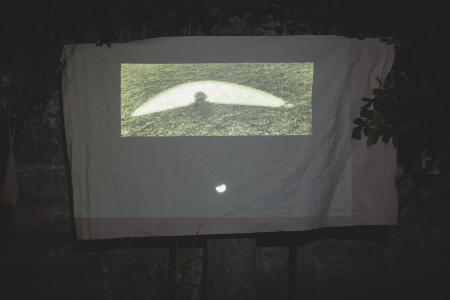
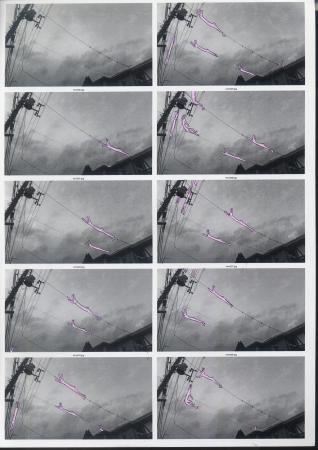
The animation film from a project "Ashita no Friends". It brings you to the emotion-free labour world of identical rabbits, whose job is to eat black shadows to salvage them from aimless strolling, gambling, and escaping. One day a rabbit fails its job, falling into a dream for the first time in its life. In the dream, the rabbit travels through a world of monsters inhabiting these shadows. This showcases a contemporary condition surrounded by capitalistic fantasy in which individuals are absorbed in the isolated experience, which traps them deeper inside capitalistic forces that strip away their agency, making them more alone and depriving them of time for human connection. Monsters and footage were made by the participants, and the making process of the film and the film itself are form of a resistance to the capitalistic force, and expression of the agency we have in our imagination.
-
 info
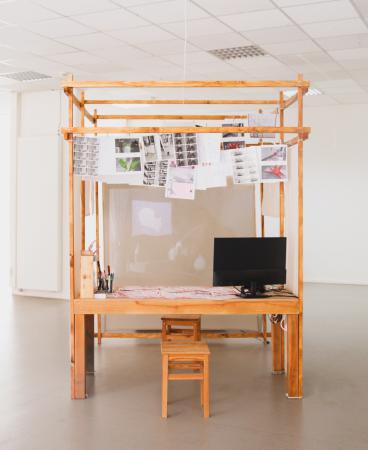
The installation of a project, "Ashita no Friends" at KABK Graduation Show. The kiosk studio showcases the process of making the animation: contextual research and a research essay film, materials collected in collaboration with participants, storyboards, and animation frames. Visitors were invited to try making monsters and imaginary friends using the same form I used in the actual making of the project. The animation film was shown as an outcome of the process on the back of the structure.
-
info
Alone in Fantasy is a research essay film from a project "Ashita no Friends"
-
info
Mijinko-pyon-pyon is a fantasy film made in collaboration with a Japanese migrant in the Netherlands. It speaks to the feeling of being lost in translation, and explores the sense of loss, and how imagination and close relationships can create a language that connects us together.
-
info
Video essay with Fabio Meinardi An experimental video by an Italian-Japanese artist duo traces the invisible forces that shape us. Through shifting, layered perspectives, it explores what it means to exist in a state of constant flux. They listen to the wind to take off, flying over the mountain. Dialogue evolves around their memory, longing for home, and the urgency to leave their home and family. The wind and the mountain represent opposing but interdependent forces—the wind shapes the mountain, but the mountain channels and challenges the wind. "Arashi" (storm) adds an element of intensity and transformation, evoking both the clash and the merging of moving identities. The storm is a weave of forces in tension, a complex phenomenon where different elements meet, collide, and transform. If we think of it as a metaphor for migration and identity, the storm becomes a place of transition, a moment where nothing is stable and everything is in flux. Arashi is not just the endpoint but the process of transformation itself—where wind and mountain meet.
-
 info
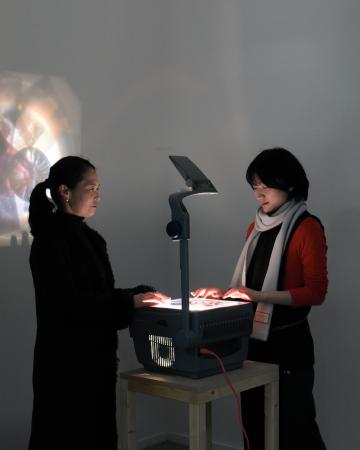
The installation of a project, "Mijinko-pyon-pyon," showcases the process of making a fantasy film with a collaborator. Photographs printed on transparent paper are placed on an overhead projector, and visitors can play with the images to create forms from overlapping images and colors for fictional storytelling. The film was shown on the other side of the wall.
-
 info
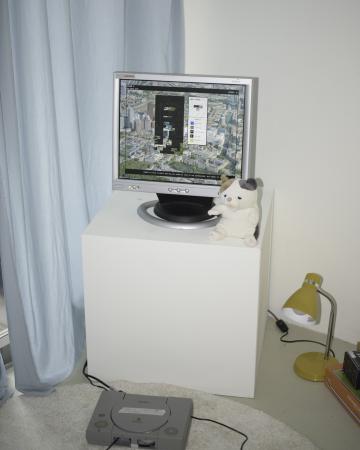
The installation of "Territoris" project from the group show "To Touch the Sun". The visitors can interact with the topic through actual game play. The game mimics Tetris is a puzzle game of land usage in the Netherlands. The futuristic images are broken into puzzle pieces, and as you accumulate the pieces, you accumulate the sounds related to the image. The flatter you make the land, the longer you can survive, while the uncontrollable incidents such as flood or rainfalls messes up your neatly aligned grids. The game play embodies the challenges of controlling nature, and questions the human life built on destruction and control.
-
 info
The installation of "In Search of Arashi," a collaborative essay film made with Fabio Meinardi, from the group show "Push, Pull, Shift."
-
 info
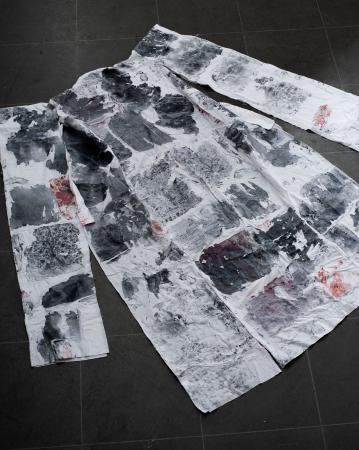
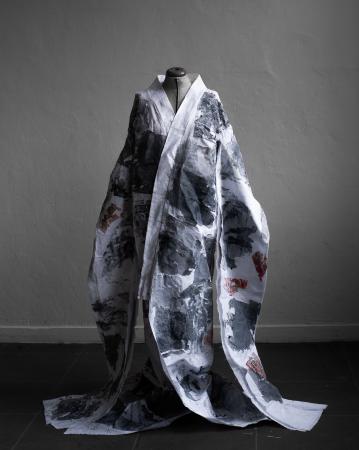
A piece from the Shiromuku project. The printed photographs of archival images are transferred onto the hand-sewn traditional garment.
-
 info
A piece from the Shiromuku project. The printed photographs of archival images are transferred onto the hand-sewn traditional garment.
-
 info
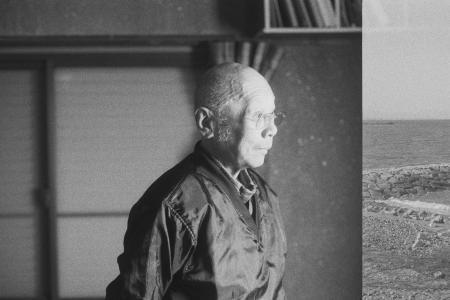
An image from the "Matsusaka" project. The man showed me the view from the window overlooking Ise Bay. The second floor of the house had been abandoned for years, ever since he got a tube in his neck and was no longer able to move freely. He gazed out of the window as if he were seeing it for the first time, his neck able to face only straight ahead.
-
 info
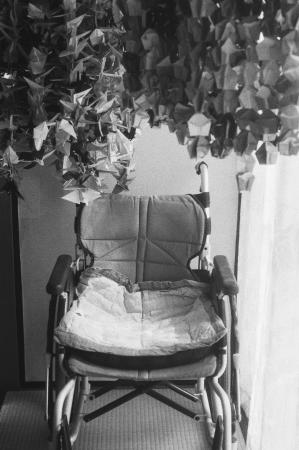
An image from the "Matsusaka" project. Traditionally, people send thousands of paper cranes chained together as a wish for peace, good health, longevity, and healing. The woman to whom the wheelchair belonged was bedridden, no longer able to speak or stand up.
-
 info
An image from the "Matsusaka" project. The man, who used to be a truck driver, spoke no words, surrounded by an ashtray full of cigarette butts and piles of sake cups next to his prescribed medicine and house bills. The caregiver gave him a massage and did some checkups, and provided medicine without commenting on how he lives.
-
") info
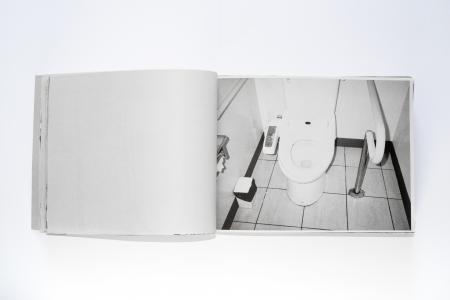
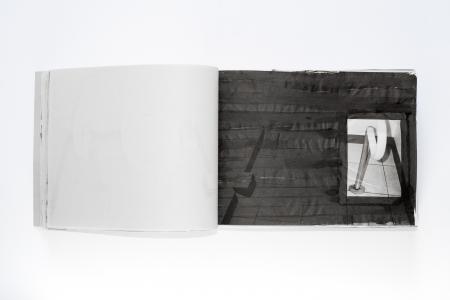
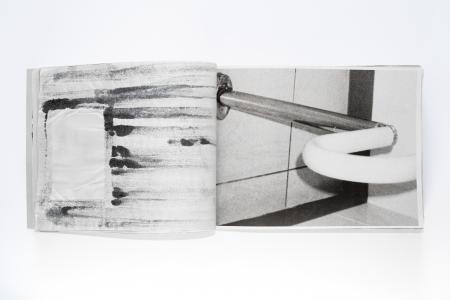
A book made for the project Have You Lived All That. The book is composed of sequences of three images taken over four days of walking. The artist took a shot with a camera every 30 minutes without thinking. The first image is the one the camera took (1), the second is the same image partially canceled out with black paint by the artist (2), and the third is only the remaining part (3).
-
info
The essay video from Have You Lived All That,
-
") info
A book made for the project Have You Lived All That. The book is composed of sequences of three images taken over four days of walking. The artist took a shot with a camera every 30 minutes without thinking. The first image is the one the camera took (1), the second is the same image partially canceled out with black paint by the artist (2), and the third is only the remaining part (3).
-
![]() info
Websites
portfolio website
saraito.comSocial media
Curriculum vitae
Education
-
2024 - 2026Master Photography & Society Den Haag, Koninklijke Academie van Beeldende Kunsten diploma
-
2015 - 2019BA Marketing and Management Hitotsubashi University diploma
exhibitions
-
2026Graduation Show: Emerging Asian Talents Namuso Gallery The Hague, Netherlands Namuso Gallery is pleased to present the second edition of Graduation Show: Emerging Asian Talents, featuring nine recently graduated artists of Asian heritage who are currently developing their practices in the Netherlands. Building on its inaugural edition, the exhibition continues Namuso Gallery's annual initiative to support emerging artists at a pivotal stage in their careers. By bringing together artists whose practices are informed by both their Asian heritage and their education in the Netherlands, the exhibition reflects the gallery's ongoing commitment to fostering dialogue between the art scenes of Asia and Europe. namuso-gallery.com/exhibitions/27-graduation-show-2026-emerging-asian-talents/ Group
-
2026Graduation Show KABK academy building The Hague, Netherlands The Royal Academy of Art, The Hague (KABK) proudly presents an exhibition with the graduation projects of artists and designers of the class of '26. The Graduation Show is the conclusion of each student’s time at the academy, showcasing their journey of personal and communal study, exploration, and growth through their final presentation. Using their work as a lens through which to see — and respond to — the world around them, the bachelor’s, master’s, and PhD students each offer a unique reflection on social and philosophical issues. graduation.kabk.nl/graduation-show Group
-
2025To Touch The Sun Paradise The Hague, Netherlands To Touch The Sun is a group exhibition by first-year students Master Photography and Society that invites audiences to take a critical look at a pressing crisis: the complex and layered spatial challenges currently facing the Netherlands. Fifteen works make up the exhibition – each taking this crisis as the starting point. The first-year students in conversation with the Dutch journalistic platform De Correspondent, invite you to join our exhibition from 9 to 14 June 2025. It will take place at Paradise, which is a collaboration venue between West Den Haag and KABK. This crisis centers around competing — and often conflicting — priorities, including housing, energy transition, water management, recreation, economic development, public health, nature conservation, and biodiversity. While these tensions may remain largely invisible to the broader public, their urgenc is becoming increasingly undeniable. Through varied visual languages and artistic strategies, the participating artists explore and interrogate these unseen pressures. The works reflect on the multiple dimensions of the crisis, offering alternative perspectives, subtle provocations, and space for dialogue. Our collective work invites viewers to engage with the critical questions shaping the physical, social, and political landscapes of the Netherlands today — and to consider what role art can play in illuminating the unseen. To Touch The Sun will feature a range of photographic, video, artistic works and installations by fifteen international image-makers from eleven countries including: Alberto Vidal Bernedo, Elena Krukonyte, Eva Chapkin, Fenna Jensma, Joanna Demarco, Julie de Ruijter, Khalil Döring, Mirko Pirisi, Marta Karkosa, Matteo Montaldo, Nadia Sheikh, Nikos Kapetanios, Odysseas Tsompanoglou, Raisa Durandi and Sara Ito. This project is an outcome of the MAPS1 Studio3 unit guided by Andrea Stultiens, Josta van Boxmeer, Bebe Agterberg, Jonathan Tang, Theo Baart, Dirk-Jan Visser, Jana Romanova and Ola Lanko. www.kabk.nl/en/events/to-touch-the-sun-by-1st-year-students-master-photography-and-society Group
-
2025Push, Pull, Shift Živi Atelje DK Zagreb, Croatia The Balkans are an «identity» heavy region. Zagreb is no exception. Some explore identity through themes related to the environment, social justice and exclusion, in a constructive way. Unfortunately, all too often unconscious biases and a lack of awareness manifest as Othering, including “benevolent othering”. This was the starting point for the 21 artists who were part of a research trip to Zagreb in collaboration with @ziviateljedk . Once we arrived, we took off and went on a journey, a journey where we explored the concepts of perceived, projected, shaped and constructed identities. www.instagram.com/p/DG8yEpVtvdE/?utm_source=ig_web_copy_link&igsh=MzRlODBiNWFlZA==&igsi=MzRlODBiNWFlZA== Group
-
2024I SAY BLUE Gallery John Kamakura, Japan (Translated from JP to ENG) Glass artist Haruna Oikawa and Kamakura-based photographer Sara Ito—who share a closely aligned artistic worldview and a long-standing friendship—will hold a two-person exhibition, "I SAY BLUE," at Kamakura Gallery John. For this exhibition, both artists have created works themed around the anticipation of the coming summer. Oikawa will present pieces from "sherbet," a series she has long been developing that incorporates glass work into everyday life. Centered on colors like pastel blue and sea green, her glass pieces express gradations reminiscent of refreshing soda and sunsets. Ito's photographic works are characterized by pastel and sepia tones, capturing a style that is both refreshing and tinged with a quiet wistfulness. This exhibition presents the exhilarating streets, people, and landscapes of early summer—while simultaneously evoking sentimental scenes that carry the melancholy of a festival's aftermath, or the end of summer. Please come see, in person, the BLUE of early summer expressed through the differing mediums of glass and photography, united by a shared artistic vision. gallery-john.jp/blogs/exhibition/20240518 Duo
Projects
-
2026
Ashita no Friends KABK MA Photography & Society The Hague, Netherlands saraito.com/ashitanofriends Ashita no Friends can be interpreted two ways: Tomorrow no Friends, or Friends of Tomorrow. Each reflects two different fantasies: a capitalistic fantasy that isolates us from each other, and another created with community in this project. My research began in a pachinko hall in Tokyo, where players sit alone with gambling machines that offer an escape from themselves. But this escape traps us deeper inside capitalistic forces that take away our agency, growing larger by feeding on individual loneliness. Modern fantasy pushes us further from others, turning even other people into content to consume. How can we break free from this cycle of consumption and loneliness, and reconnect with the feelings we want to escape, and with each other? Before capitalism offered an escape from oneself, communities had other tools to engage with the world, such as yokai. Yokai are monsters that pre-modern Japanese society used to name the unknown, whether from nature or our own minds. These creatures were shared through stories and rituals, so that no one had to face the unknown alone. I had participants create their own monsters and imaginary friends, and filmed the everyday places where these beings appear. I animated their creatures into that footage, weaving imagination and reality together. By doing so, I give form to the uncanny inside us, the way our predecessors once did with yokai. The film illustrates that what is imagined does exist, manifesting the inner reality of people into physical form.
-
2025
Mijinko-pyon-pyon KABK MA Photography & Society Tha Hague, Netherlands saraito.com/mijinko-pyon-pyon Mijinko-pyon-pyon unfolds as a performative act of seeing and naming. Created in collaboration with another Japanese woman who migrated to the Netherlands, the video captures a process of exchanging and interpreting everyday photographs. The original meaning of each photo transforms into a fantasy or philosophical world that reflects our inner selves. My collaborator and I form a dialogue in which one voice represents the grown-up who has learned to see the world through language, logic, knowledge, and bias, and the other represents the child, who, with fewer of these filters, uses free imagination to create new meaning from what they see. At first, they experience moments of being lost in translation, but as the conversation continues, the adult gradually reclaims a way of seeing that is less burdened by familiar filters. These two voices could also belong to one person, revealing two conflicting modes of perception within the self. Through this playful, sometimes painful exchange, the work questions how belonging, alienation, and translation shape our ways of looking. Mijinko-pyon-pyon invites the viewer into a fragile space of misrecognition and co-creation, asking whether we ever truly see what others see and how we might belong to one another or to a larger community through shared language and visuals.
-
2025
In Search of Arashi KABK MA Photography & Society Zagreb saraito.com/arashi An experimental video by an Italian-Japanese artist duo traces the invisible forces that shape us. Through shifting, layered perspectives, it explores what it means to exist in a state of constant flux. They listen to the wind to take off, flying over the mountain. Dialogue evolves around their memory, longing for home, and the urgency to leave their home and family. The wind and the mountain represent opposing but interdependent forces—the wind shapes the mountain, but the mountain channels and challenges the wind. "Arashi" (storm) adds an element of intensity and transformation, evoking both the clash and the merging of moving identities. The storm is a weave of forces in tension, a complex phenomenon where different elements meet, collide, and transform. If we think of it as a metaphor for migration and identity, the storm becomes a place of transition, a moment where nothing is stable and everything is in flux. Arashi is not just the endpoint but the process of transformation itself—where wind and mountain meet.
-
2025
Territoris KABK MA Photography & Society The Hague, Netherlands saraito.com/territoris Territoris invites players to engage with the sense of disconnection that arises when imagining the future. It’s a puzzle game inspired by Tetris where you to deconstruct and reassemble the Dutch landscape of present and future. What does it mean to dwell in the space illustrated in speculation? The gameplay embodies the constant human and non-human negotiation over space, questioning the given idea of the future. While examining each element of the utopia as it falls, the landscape and soundscape accumulate and then disappear, embodying the temporality of the space we inhabit. The blocks, representing the competing needs of the country, must fit cleanly, while interruptions of floods and storms take away your control. It’s a puzzle game that never allows you to stop — just as in real life, where you must constantly negotiate your space in order to live. I invite players to engage with these scenarios and reimagine the future of the Netherlands. The process started with my own struggle to grasp the urgency of spatial planning. I wanted to make the issue more tangible and accessible. My solution was a game built in p5.js, designed in five stages with backgrounds of Dutch landscapes. Each falling block carries a fragment of these images, accompanied by ambient sounds: forest rustles if the block is green, water sounds if it is blue. The sounds accumulate as blocks pile up, while random events mimic the disruptions of climate and flooding. Through play, I hope to shift the discussion from distant policy to lived imagination. The speculative images of the future by Talking Landscape Sound and Music by Parvin Diyanat & Jake Parry Made in conversation with De Correspondent
-
2024
Shiromuku KABK MA Photography & Society The Hague, Netherlands saraito.com/shiromuku Shiromuku, a traditional Japanese bridal garment, is a cultural symbol of patriarchal values. Its whiteness is meant to cleanse a woman’s past, presenting her as pure, blank, and unmarked as she enters her husband’s family. I return to a photograph of my mother, who wore shiromuku at her wedding and became a full-time housewife, and to the unconventional name she gave me. The name “Sara” traces back to sarasa textiles, known for their vibrant and intricate patterns originating in India. They were introduced to Japan in the 16th and 17th centuries through maritime trade by Portuguese and Dutch merchants, and were celebrated within urban merchant culture. What did it mean for women to dress themselves in such exotic garments, carrying a sense of desire and self-expression? I imagined a tension between these two forms of dress: one erases traces of the past and performs ideals of purity and virtue, while the other carries traces of global exchange and celebrates hybridity. I sewed a shiromuku from plain white fabric and stained it with images: ruins along the Silk Road, traces of craft and exchange, records of diseases that traveled across borders, a solitary bride, and patterns embedded in my name. This act resists the purification of the histories and memories that women carry. I am not the “authentic” Japanese woman you imagine. I stand with the freedom my mother gave me, and within a shared history that crosses the waters between us. I will remember the stains I have inherited. I am ready to carry the ones that are yet to come.
-
2024
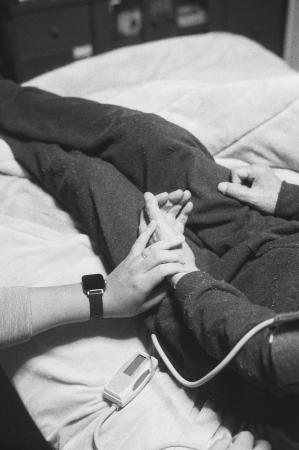
Matsusaka Matsusaka, Japan saraito.com/matsusaka In collaboration with a hospice institution that provides hospice care in a town, Matsusaka (松坂) in Mie Prefecture, I had the opportunity to visit nine individuals who opt for palliative care at home rather than life-prolonging treatments. The images I captured reflect my encounters during these visits—the smell of excrement, the musty rooms, piles of personal belongings covered in dust, traces of family tension, the boredom, and the ever-present background noise of the television. The project explores the emotional landscape of those who provide care, and receive, by going into the realities of end-of-life care.
-
2023
Have You Lived All That Kamakura, Japan saraito.com/haveyoulivedallthat In Have You Lived All That, I surrendered to the ritual of the camera as a machine. I walked through cities and mountains, taking a photograph every thirty minutes as the alarm rang, with the question in mind “Can we stop thinking of photogenic moment with a camera in hand?” By refusing the instinct to choose what to frame (and what to frame out), I attempted to become an operator of the camera . Yet in the end, I saw the trace of my gaze and realized the true absence of myself was impossible. In the editing process, I reclaimed agency, reframing and reinterpreting what the apparatus captured. The work questions the myth of objectivity in photography, revealing the entanglement of intention, manipulation, and machine. It invites the audience to wonder: can we ever fully erase ourselves from the act of seeing? Can we erase the camera from our life experience? "A way of certifying experience, taking photographs is also a way of refusing it-by limiting experience to a search for the photogenic, by converting experience into an image, a souvenir. " -Susan Sontag
Publications
-
20262nd edition (W)HOLE Book Screwdriver Screwdriver The Hague, Netherlands screw-driver.xyz/?utm_source=ig&utm_medium=social&utm_content=link_in_bio&fbclid=PAcGRvZgJleHRuA2FlbQIxMQBzcnRjBmFwcF9pZA85MzY2MTk3NDMzOTI0NTkAAacuWj02Rzbbx2QYBn70BPX4Kvb1_39DbQI5onaLZHfjbvtd3lV4Y79PY91M6A_aem_RvKImzs45h0E5qIQALvXxg My research on "Ashita no Friends" project was featured on the second edition focuses on (W)HOLE. I created a collage of text and research materials, titled "Alone in Fantasy" ---- (description of the magazine) In the algorithm driven post-truth era, the world order that we know of crumbles a bit more each day due to our collective humanitarian agreements being desecrated by techno-oligarchs, cannibalistic pedophile billionaires and warmongering politicians. Navigating our lives in this environment gets harder each day as the ground we stand on crumbles, leaving dark sinkholes in its place. So rather than waiting in vain for these holes to be blatantly patched up, missing our chances of peeking into very-maybe-a-bit-100%-true post-truths, we invite you to take a leap of faith like Alice through a (w)hole of your choosing. Look at the (w)holes and its parts: complex systems, extractive practices, conspiracy theories, wormholes, heartbreaks, grave diggers, caves, tunnels, loopholes, manholes, black holes and much more. It might be obvious what was sitting in front of your face at first, but just be careful when sticking in your nose, since holes prove to be a fertile ground for murky waters. Maybe it will be a gateway to 7 minutes in heaven providing you with godly knowledge; maybe it will be your reason to have an Icarian fall towards the pits of modernized hell. With the second issue of screw*driver magazine, (W)HOLE, we want to provide an opportunity for you to approach and rummage in areas that you would not usually look into.
-
2019No 07 'Decelerate' eye_C mag Book eye_C eye_C Tokyo, Japan www.eyecmag.com/news/2022/11/11/eyec-mag-no-07-decelerate My photography series "Winter Story" was featured --- We’re pleased to announce the release of eye_C mag No. 07 titled ‘Decelerate’ In ’Decelerate’, which is also our 5th Anniversary issue, we take a step back to deliver a mostly visual project with some of our favourite brands out there. Our covers this time includes a 04:00 AM sunrise shoot in Tokyo with yoshiokubo, a heavily heritage focused editorial with visvim and finally a closer look at F/CE.’s seasonal collaboration with NANGA. Furthermore we take an i debt look at White Mountaineering’s Autumn/Winter lineup, the latest from COVERCHORD Women and a full breakdown of nonnative’s 42nd collection. You’ll also find editorials with Tokyo mainstays F.C.R.B., uniform experiment and SOPHNET. among others as well as a travel journal from the North with HHV. Lastly we’ve highlighted our seasonal eye_C collaborations, this time with thisisneverthat, S.F.C., HERILL, yoshiokubo and ROTOTO which will be available at our Tokyo pop-up later this month.