-
") info
info -
 info
info -
 info
infohttps://panseeatta.com/index.php/2025/10/07/flight-into-egypt/
-
 info
info -
 info
info -
 info
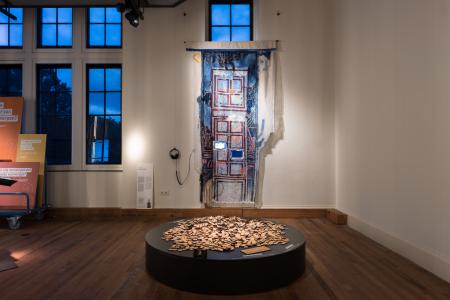
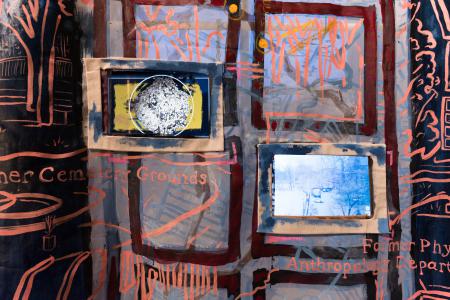
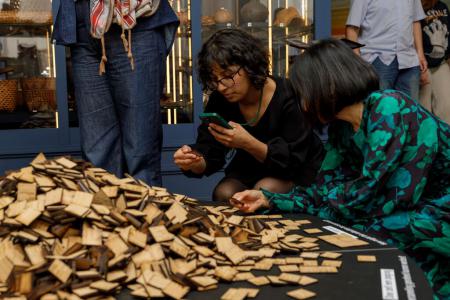
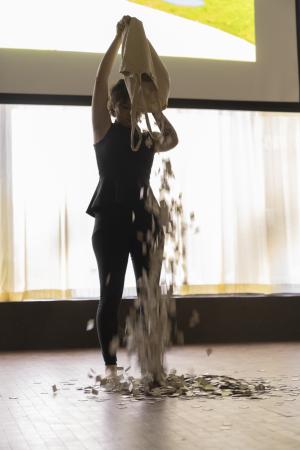
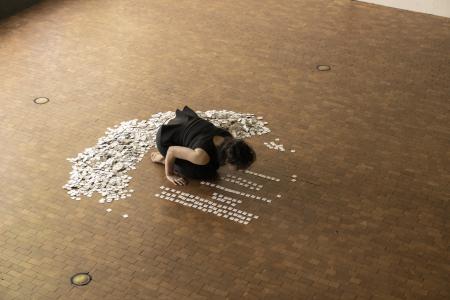
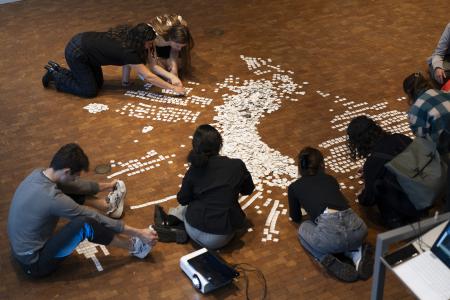
infoInstallation at Wereldmuseum Amsterdam. To make one particle is a multi-part installation examining the histories and trajectories of the Wereldmuseum’s collection of human remains in relation to this museum’s site atop the former Oosterbegraafplaats. It consists of multiple means of visualizing the catalogue data associated with these remains. The banner traces their places of origin from former Dutch colonies and the Netherlands itself, situating them within current sites visible just beyond the gallery window. Within the banner are two videos: one envisioning a memorial to these remains as columns in the Oosterpark, their heights representing the volume of catalogue data associated with each. The other is a timelapse of visitors’ ongoing interactions with the mass of laser-cut tabs, each inscribed with individual catalogue information.
-
 info
infoInstallation at Wereldmuseum Amsterdam. To make one particle is a multi-part installation examining the histories and trajectories of the Wereldmuseum’s collection of human remains in relation to this museum’s site atop the former Oosterbegraafplaats. It consists of multiple means of visualizing the catalogue data associated with these remains. The banner traces their places of origin from former Dutch colonies and the Netherlands itself, situating them within current sites visible just beyond the gallery window. Within the banner are two videos: one envisioning a memorial to these remains as columns in the Oosterpark, their heights representing the volume of catalogue data associated with each. The other is a timelapse of visitors’ ongoing interactions with the mass of laser-cut tabs, each inscribed with individual catalogue information.
-
 info
infoInstallation at Wereldmuseum Amsterdam. To make one particle is a multi-part installation examining the histories and trajectories of the Wereldmuseum’s collection of human remains in relation to this museum’s site atop the former Oosterbegraafplaats. It consists of multiple means of visualizing the catalogue data associated with these remains. The banner traces their places of origin from former Dutch colonies and the Netherlands itself, situating them within current sites visible just beyond the gallery window. Within the banner are two videos: one envisioning a memorial to these remains as columns in the Oosterpark, their heights representing the volume of catalogue data associated with each. The other is a timelapse of visitors’ ongoing interactions with the mass of laser-cut tabs, each inscribed with individual catalogue information.
-
info
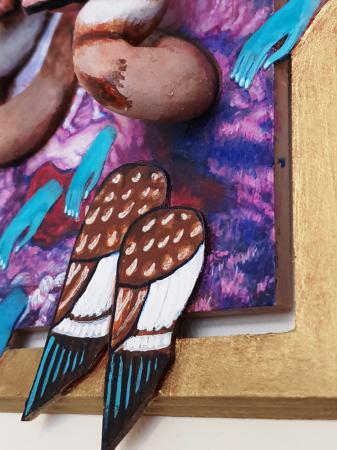
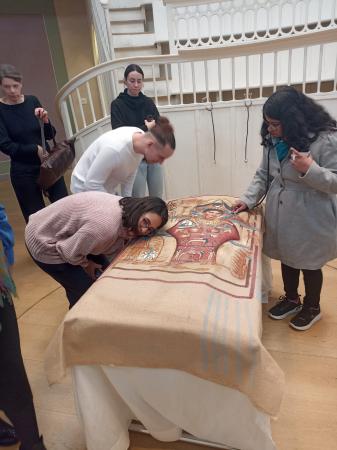
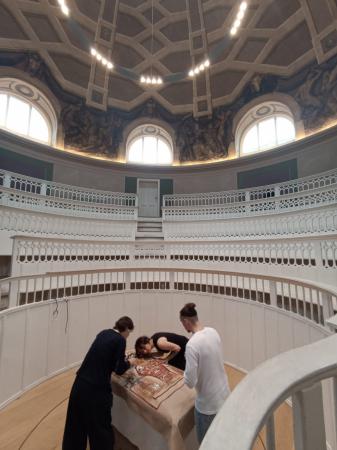
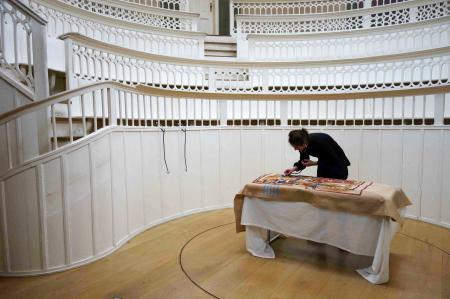
50.650 Is There Breath In It, The West uses a hand-painted replica of an Ancient Egyptian funerary shroud with embedded electronic elements telling the story of different winged symbols, asking how they allow us to better understand our relationship with nature, life, and death. Based on a Ptolemaic-era portrait shroud currently housed in the Boston Museum of Fine Art (see link below for details), it draws attention to the ways that humans have long considered our complex relationships with the natural world, imagining hybrid creatures that play important roles in mediating our relationship with life and death. Echoes of the winged humanoid ba figure, for example, may be seen across Egypt’s diverse faith traditions in symbols like angels. At the same time, this project combines multiple overlapping hybridities: high tech and traditional artistic media, differing Greco-Roman and Ancient Egyptian visual styles, and of course, animal-human hybrid creatures are a prominent part of Ancient Egyptian mythologies. Similarly, its title, 50.650 ls There Breath In It, The West, combines its original museum inventory number with a prayer from a Ptolemaic-era funerary ritual, bringing together both the objectifying distance with which museums have regarded such objects, and the human element of grief, hope, and loss. Along these lines, by encouraging the use of both medical and tactile means of listening to the audio narratives, this project imagines counter-museological means of engaging with Ancient Egyptian human remains and grave goods. Through a form of reimagined funerary ritual that brings together the ancient and modern, this project asks how embodied participation with otherwise untouchable objects might re-imbue the hurma – the autonomy or inviolability – of the ancient dead.
-
 info
infohttps://www.materialculture.nl/en/events/make-one-partickle-public-soul-all-things Using traditional media and open-source technology, Egyptian artist Pansee Atta grapples with the history and ethics of museum collections of human remains. This site-specific performance at the Wereldmuseum Amsterdam links the history of the Oosterpark’s disinterred cemetery with the museum’s human remains, from both Amsterdam and colonial sites around the world. It visualizes the scope of the Wereldmuseum’s collection of human remains, as well the decontextualization resulting from its lack of documentation. Situating the viewer in a large-scale, virtual field of columns representing individual human “entities” in the collection, To make one partickle of the public soul of all things combines data visualization and rituals of memorialization to think through what ought to be revealed or concealed in public collections. Taking its name from Thomas Browne’s 1658 rebuke of the trade in Egyptian mummies in response to his work in Dutch anatomical collections, To make one partickle […] draws a web of connections between the Netherlands and Global South through stories of the bodies that lie above and below the museum’s displays. It asks: what do the living owe the dead, and how are our collective autonomies entangled in this particular place? How do projects of ‘progress’ dehumanize European and non-European bodies alike, and how do we restore a portion of our shared dignities? How might we envision a future in which the dead and living are liberated alike; not as matter but as entities which defy containment?
-
 info
infohttps://www.materialculture.nl/en/events/make-one-partickle-public-soul-all-things Using traditional media and open-source technology, Egyptian artist Pansee Atta grapples with the history and ethics of museum collections of human remains. This site-specific performance at the Wereldmuseum Amsterdam links the history of the Oosterpark’s disinterred cemetery with the museum’s human remains, from both Amsterdam and colonial sites around the world. It visualizes the scope of the Wereldmuseum’s collection of human remains, as well the decontextualization resulting from its lack of documentation. Situating the viewer in a large-scale, virtual field of columns representing individual human “entities” in the collection, To make one partickle of the public soul of all things combines data visualization and rituals of memorialization to think through what ought to be revealed or concealed in public collections. Taking its name from Thomas Browne’s 1658 rebuke of the trade in Egyptian mummies in response to his work in Dutch anatomical collections, To make one partickle […] draws a web of connections between the Netherlands and Global South through stories of the bodies that lie above and below the museum’s displays. It asks: what do the living owe the dead, and how are our collective autonomies entangled in this particular place? How do projects of ‘progress’ dehumanize European and non-European bodies alike, and how do we restore a portion of our shared dignities? How might we envision a future in which the dead and living are liberated alike; not as matter but as entities which defy containment?
-
 info
infohttps://www.materialculture.nl/en/events/make-one-partickle-public-soul-all-things Using traditional media and open-source technology, Egyptian artist Pansee Atta grapples with the history and ethics of museum collections of human remains. This site-specific performance at the Wereldmuseum Amsterdam links the history of the Oosterpark’s disinterred cemetery with the museum’s human remains, from both Amsterdam and colonial sites around the world. It visualizes the scope of the Wereldmuseum’s collection of human remains, as well the decontextualization resulting from its lack of documentation. Situating the viewer in a large-scale, virtual field of columns representing individual human “entities” in the collection, To make one partickle of the public soul of all things combines data visualization and rituals of memorialization to think through what ought to be revealed or concealed in public collections. Taking its name from Thomas Browne’s 1658 rebuke of the trade in Egyptian mummies in response to his work in Dutch anatomical collections, To make one partickle […] draws a web of connections between the Netherlands and Global South through stories of the bodies that lie above and below the museum’s displays. It asks: what do the living owe the dead, and how are our collective autonomies entangled in this particular place? How do projects of ‘progress’ dehumanize European and non-European bodies alike, and how do we restore a portion of our shared dignities? How might we envision a future in which the dead and living are liberated alike; not as matter but as entities which defy containment?
-
 info
infohttps://inherit.hu-berlin.de/events/listening-in-practice-a-unique-iterative-rehearsal-of-sound-artistic-research-at-inherit
-
 info
infohttps://inherit.hu-berlin.de/events/listening-in-practice-a-unique-iterative-rehearsal-of-sound-artistic-research-at-inherit
-
 info
infohttps://inherit.hu-berlin.de/events/listening-in-practice-a-unique-iterative-rehearsal-of-sound-artistic-research-at-inherit
-
info
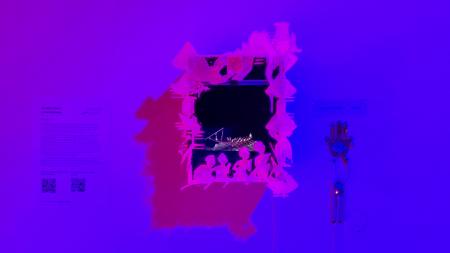
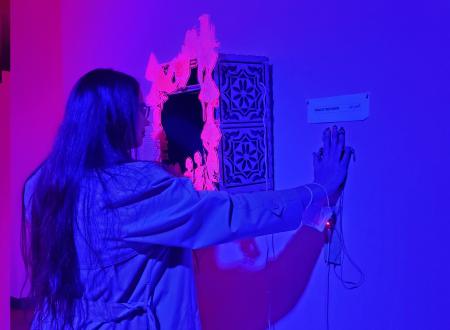
Currelley’s Afreet, or: the Qufti Strike (عفريت كرلي أو الإضراب القفطي) examines the colonial history of the Royal Ontario museum’s Ancient Egyptian collection using autobiographical accounts of the museum’s founder, Charles Trick Currelly, and covertly scanned 3d models of exhibited objects. It bases its narrative around two excerpts from Currelly’s 1956 autobiography, in which his archaeological expedition in the southern city of Quft was impeded when local labourers were forewarned of its dangers by a decades-old magical prophecy and the vision of an ‘afreet’, a trickster spirit. Rather than regarding this disruption as a form of ignorance or superstition, this project recasts the historical event as a form of organized labour action, an anti-colonial strike set in motion by the combined efforts of humanity and djinn. In this interactive painted- and laser-cut artwork, viewers are invited to touch the ornamental brass hand to intervene upon the museum’s exhibited objects so the labourers therein, like those in Currelly’s narrative, can lay down their tools and rest.
-
 info
infohttps://panseeatta.com/index.php/art-projects/currelleys-afreet-or-the-qufti-strike/
-
 info
infohttps://panseeatta.com/index.php/art-projects/currelleys-afreet-or-the-qufti-strike/
-
 info
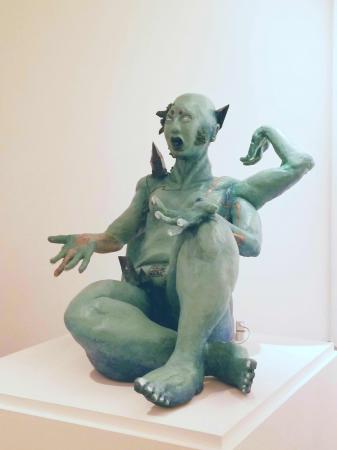
infoThis sculpture was conceived as part of To Be Continued: Troubling the Queer Archive, an exhibition set to open September 19th in a semi-virtual form at Carleton University Art Gallery in Ottawa, Canada. The show, curated by Anna Shah Hoque and Cara Tierney, examines queer BIPOC histories, and so my premise was to create this life-sized, figurative archive of LGBTQ identities in Middle Eastern history. I used the visual reference to henna, a very interpersonal, bodily practice, to make a conductive surface out of copper tape and conductive pigments, which works as an antenna for a capacitive sensor, which, in turn, controls the volume of the audio that emits from the speaker in the mouth. The audio tells the story of Qamar-al-Zaman and Princess Budour from the 1001 Nights. With records dating back to the 14th century Middle East , it tells a fun, raunchy story of gender-bending and same-sex desire, as well as misunderstandings, adventure, and mischievous Jinn. It challenges the way gender norms in Muslim history are understood, and to hear it, you need to get very physically close to the sculpture, generating a kind of intimacy with your body’s electric capacitance and its androgynous form and many limbs. While it was initially conceived as a directly touchable artwork, it was re-thought a bit due to the pandemic, with distance- instead of touch-sensing to perform the same functions without, y’know, risking viewer’s lives. To historically preserve the archive, I created a perma.cc link with the project audio, schematic, and various forms of documentation, all of which can be accessed through the QR code on the figure’s belly. In my mind, this figure is a sort of time traveller, sent from a future in which gender and sexual identity is freely determined, sent back in time to tell us of a part of our history which we’ve forgotten. This is part of why it’s covered in crystals: used for timekeeping, I think of its body and our bodies as historical archives in their own right, accessed though intimacy, connection, and the intrinsic capacitance they create.
Websites
Personal website
www.panseeatta.comProject website I coded; also created the data visualizations
www.mobilesubjects.orgSocial media
Member of a professional association/artists’ association
Canadian Artists' Representation/Le Front des artistes canadiens (CARFAC)
Curriculum vitae
Education
-
2016 - 2019Diploma Curatorial Studies Carleton University diploma
-
2016 - 2022PhD Cultural Mediations (Visual Culture) Carleton University
-
2013 - 2015MA Cultural Studies Queen's University
-
2006 - 2010BFA Bachelor of Fine Arts Queen's University
exhibitions
-
2025Onvoltooid verleden: teruggeven, houden, of…? Wereldmuseum Amsterdam Amsterdam, Netherlands Debat over restitutie: In deze nieuwe tentoonstelling stap je in het midden van dit actuele debat over restitutie. Ontdek de verschillende perspectieven, dilemma’s en verhalen achter de objecten. Duik in herkomstonderzoeken en onderzoek zelf hoe complex de vragen rondom eigenaarschap en waarde kunnen zijn. Welke toekomst zie jij voor de collecties van Wereldmuseum? Teruggeven, houden, of…? Naast historische objecten speelt hedendaagse kunst een belangrijke rol in de tentoonstelling. Kunstenaars en collectieven Pansee Atta, Daniel Aguilar Ruvalcaba, Aram Lee, Zara Julius & Zoé Samudzi, Hande Sever & Gelare Khoshgozaran en Lifepatch geven hun kritische, creatieve en emotionele visie op de toekomst van dit cultureel erfgoed. amsterdam.wereldmuseum.nl/nl/zien-en-doen/tentoonstellingen/onvoltooid-verleden Group
-
2024Listening in Practice Tieranatomisches Teater Berlin, Germany What does listening to animal sounds entail? Can somatic listening interpret archival data? How do sounds migrate and what can sounds of migration reveal about the politics of hearing and dynamics of heritage? Listening in Practice was the fourth event in this year’s artistic research series at the Centre for Advanced Study inherit. heritage in transformation. It was the product of a co-curated and co-choreographed process between inherit’s five artistic research fellows: Pansee Abou ElAtta, Juana Awad, Dani Gal, Raviv Ganchrow, and Daina Pupkevičiūtė together with Tal Adler (coordinator of artistic research at inherit). This group of artistic-researchers had collaboratively arranged a multilayered rehearsal experience featuring sound installations and performances spread across several locales of the Hermann von Helmholtz-Zentrum für Kulturtechnik (HZK): the spaces of the Tieranatomisches Theater (TA T), the Objektlabor, and their surroundings. Arranged around focused interventions in multiple locations around the TA T and the Objektlabor, Listening in Practice was conceived as a rehearsal event in which iterative listening, and iterations of performativity, invite a discussion on the epistemologies, and politics, of situated hearing. In the TA T’s Meshwork of Things room, Dani Gal deployed his Semi Automatic setup – an installation that uses sound generating devices (such as a radio receiver, recorded sounds, or electro magnetic recorders) to mechanically and electronically activate other sound sources, such as musical instruments. By using sound activated small electric-motors to vibrate string instruments which by turn generated electronic noises through another device, a dialogue between two or more sound sources was activated. In relation to Gal’s endeavors within inherit’s transforming value theme, the sound sources, which the player had only partial control over, created an indeterminate musical composition. Within the historical venue of the animal dissection arena, Pansee Abou ElAtta, used a replicated Ancient Egyptian funerary shroud embroidered with interactive electronic elements that relay prayers for the deceased, to offer counter-museological means of engaging with Ancient Egyptian human remains and grave goods. Embedded within inherit’s decentering the west theme, this installation asked how embodied participation with otherwise untouchable objects might re-imbue Ḥurma of the ancient dead. Set in measure with architectonic attributes inherit.hu-berlin.de/events/listening-in-practice-a-unique-iterative-rehearsal-of-sound-artistic-research-at-inherit Group
-
2023We liberate one another Corridor 45| 75 Ottawa, Canada Based on the output of a 2019 residency with SAW Video, this project was conceived in response to local histories of containment and control. Ottawa’s history, like its geography, closely follows that of the Canal, which originated as a large-scale means of controlling both the natural movement of water and the patterns of human migration and settlement. This project asks: how do we resist these histories of colonial control by becoming excessive, uncontainable Using the Corridor 45|75 display space as a metaphor for the Rideau Canal and its system of locks, these colourful, monstrous figures aid one another through and past the physical and social obstacles that would contain them. The vinyl and acrylic layers break up the figures’ outlines, visually melding them into a colourful mass of interlinked bodies. www.facebook.com/photo.php?fbid=1053721249361296&set=a.742592993807458&type=3 Solo
-
2021All Good Things Come in Threes Deutsche Digitale Bibliotek Online, Germany The Rosetta Stone continues to fascinate people – as a symbol of languages and understanding, even in an ancient culture. Competences in intercultural communication belong to the challenges of humanity. It was the digitization of ancient languages and scholarship in general which re-introduced the Rosetta Stone to our attention – a monument intertwined with the birth of the academic discipline of Egyptology. There is still a lot of potential in deciphering and interpreting ancient sources, especially in dealing with the Demotic language and script. Current and future scholars have a couple of tough nuts to crack! Furthermore, the Rosetta Stone is part of discourses about ancient and modern discussions on handling artifacts in the 21st century. It remains exciting! ausstellungen.deutsche-digitale-bibliothek.de/rosetta-stone Group
-
2019We only liberate ourselves by binding our liberations with those of one another SAW Video (public installation) Ottawa, Canada How can public art work with, against and beyond the monumental? How can it scale up to address the monumentality of environmental extraction, the long reverberations of colonial violence, or the depths of ideological entrenchments? Pansee Atta explores these questions in her video projection we only liberate ourselves by binding our liberations to those of one another, which visualizes the counter-monumental as an intervention upon a practice that has directly shaped local histories, politics and geographies in the National Capital Region: the containment of water - a legacy manifested most prominently in the Rideau Canal and Chaudière Falls. Understanding containment of bodies - of water and persons – to be a foundational ordering logic of colonial expansion, Atta uses her video projection to create a space of excess, setting in motion a counter-flow of uncontainable, surging corporeality. Streams of animated bodies, ungovernable in their form and function, reject atomization to operate as a fundamentally interdependent swarm of subjectivities. Assembling perpetually, they scale up a rocky natural facade of Victoria Island, seemingly emerging out of the watery depths and interacting with the contours of their environment. Rather than creating a discrete, contained video with a fixed duration, Atta’s compositional strategy is itself an uncontainable system, operating on a continuously running animation script that randomly generates streams of monstrous figures, each mutually aiding one another as they scale the height of the frame. As such, Atta’s work may be viewed indefinitely without encountering a single repetition – a formal irreducibility that exceeds the structural rigor of containment and its relations of enclosure. This is an unruly radiance, bound together by allyship, and borne of a shared struggle. www.sawvideo.com/knot/projection/we-only-liberate-ourselves-binding-our-liberations-those-one-another Solo
-
2016Myth Marks Galerie La Centrale Powerhouse Montreal, Canada Myth Marks is series of animations by Pansee Atta, which considers the ways that the ethnographic display of Muslims and Islam in Canadian cultural institutions contributes to ongoing projects of colonization. By thinking through ethnography from an affective, bodily perspective, these works critique the Orientalizing gaze of the cultural institution, suggesting instead a way of thining through representation that prioritizes racialized, gendered voices. By using text as well as still and animated images, these works reveal the ways that art and politics work together to create fearful myths under the seductive guise of ornate decoration. Pansee Atta is an emerging Ottawa-based Egyptian-Canadian artist, whose practice is often collaborative and community-driven. Her work considers themes of colonization, feminism, and Islam, as well as the role of the cultural institution in legacies of epistemic violence. She is a recent graduate of the MA program in Cultural Studies at Queen’s University, in which her project investigated the decolonization of museums. www.youtube.com/watch?v=tKTAAwdk35Y Solo
Projects
-
2025
To make one particle Wereldmuseum Amsterdam Amsterdam, Netherlands www.dutchnews.nl/2025/06/skeleton-in-the-closet-show-asks-questions-on-colonial-objects/ To make one particle is a multi-part installation examining the histories and trajectories of the Wereldmuseum’s collection of human remains in relation to this museum’s site atop the former Oosterbegraafplaats. It consists of multiple means of visualizing the catalogue data associated with these remains. The banner traces their places of origin from former Dutch colonies and the Netherlands itself, situating them within current sites visible just beyond the gallery window. Within the banner are two videos: one envisioning a memorial to these remains as columns in the Oosterpark, their heights representing the volume of catalogue data associated with each. The other is a timelapse of visitors’ ongoing interactions with the mass of laser-cut tabs, each inscribed with individual catalogue information.
-
2024
50.650 Is There Breath In It, The West Berlin, Germany panseeatta.com/index.php/art-projects/there-is-breath-in-it/ 50.650 Is There Breath In It, The West uses a hand-painted replica of an Ancient Egyptian funerary shroud with embedded electronic elements telling the story of different winged symbols, asking how they allow us to better understand our relationship with nature, life, and death. Based on a Ptolemaic-era portrait shroud currently housed in the Boston Museum of Fine Art (see link below for details), it draws attention to the ways that humans have long considered our complex relationships with the natural world, imagining hybrid creatures that play important roles in mediating our relationship with life and death. Echoes of the winged humanoid ba figure, for example, may be seen across Egypt’s diverse faith traditions in symbols like angels. At the same time, this project combines multiple overlapping hybridities: high tech and traditional artistic media, differing Greco-Roman and Ancient Egyptian visual styles, and of course, animal-human hybrid creatures are a prominent part of Ancient Egyptian mythologies. Similarly, its title, 50.650 ls There Breath In It, The West, combines its original museum inventory number with a prayer from a Ptolemaic-era funerary ritual, bringing together both the objectifying distance with which museums have regarded such objects, and the human element of grief, hope, and loss. Along these lines, by encouraging the use of both medical and tactile means of listening to the audio narratives, this project imagines counter-museological means of engaging with Ancient Egyptian human remains and grave goods. Through a form of reimagined funerary ritual that brings together the ancient and modern, this project asks how embodied participation with otherwise untouchable objects might re-imbue the hurma – the autonomy or inviolability – of the ancient dead.
-
2023
Currelley’s Afreet, or: the Qufti Strike Toronto, Canada panseeatta.com/index.php/art-projects/currelleys-afreet-or-the-qufti-strike/ his art project examines the colonial history of the Royal Ontario museum’s Ancient Egyptian collection using autobiographical accounts of the museum’s founder, Charles Trick Currelly, and covertly scanned 3d models of exhibited objects. It bases its narrative around two excerpts from Currelly’s 1956 autobiography, in which his archeological expedition in the southern city of Quft was impeded when local labourers were forewarned of its dangers by a decades-old magical prophecy and the vision of an ‘afreet‘, a trickster spirit. Rather than regarding this disruption as a form of ignorance or superstition, this project recasts the historical event as a form of organized labour action, an anti-colonial strike set in motion by the combined efforts of humanity and djinn. In this interactive painted- and laser-cut artwork, viewers are invited to touch the ornamental brass hand to intervene upon the museum’s exhibited objects so the labourers therein, like those in Currelly’s narrative, can lay down their tools and rest.
-
2022
The Moon Upon its Fourteenth Night Carleton University Art Gallery Ottawa, Canada This sculpture was conceived as part of To Be Continued: Troubling the Queer Archive, an exhibition set to open September 19th in a semi-virtual form at Carleton University Art Gallery in Ottawa, Canada. The show, curated by Anna Shah Hoque and Cara Tierney, examines queer BIPOC histories, and so my premise was to create this life-sized, figurative archive of LGBTQ identities in Middle Eastern history. I used the visual reference to henna, a very interpersonal, bodily practice, to make a conductive surface out of copper tape and conductive pigments, which works as an antenna for a capacitive sensor, which, in turn, controls the volume of the audio that emits from the speaker in the mouth. The audio tells the story of Qamar-al-Zaman and Princess Budour from the 1001 Nights. With records dating back to the 14th century Middle East , it tells a fun, raunchy story of gender-bending and same-sex desire, as well as misunderstandings, adventure, and mischievous Jinn. It challenges the way gender norms in Muslim history are understood, and to hear it, you need to get very physically close to the sculpture, generating a kind of intimacy with your body’s electric capacitance and its androgynous form and many limbs. While it was initially conceived as a directly touchable artwork, it was re-thought a bit due to the pandemic, with distance- instead of touch-sensing to perform the same functions without, y’know, risking viewer’s lives. To historically preserve the archive, I created a perma.cc link with the project audio, schematic, and various forms of documentation, all of which can be accessed through the QR code on the figure’s belly. In my mind, this figure is a sort of time traveller, sent from a future in which gender and sexual identity is freely determined, sent back in time to tell us of a part of our history which we’ve forgotten. This is part of why it’s covered in crystals: used for timekeeping, I think of its body and our bodies as historical archives in their own right, accessed though intimacy, connection, and the intrinsic capacitance they create.
-
2018
I Am Not Asking For the Moon Halifax, Canada web.archive.org/web/20241108111107/https://www.unpackingthelivingroommsvu.ca/artists/pansee-atta/
International exchanges/Residencies
-
2024Pressing Matter Amsterdam, Netherlands Artist-in-residence with Wereldmuseum & Rijksakademie. Description: The Rijksakademie partners in Pressing Matter, a four-year research programme, coordinated by the Vrije Universiteit Amsterdam, that connects fundamental theories of valuation and property to postcolonial debates on heritage. The goal is to develop and test new theoretical models of value and ownership and new forms of return that extend current approaches to heritage restitution. Participating artists are invited to think about the ways in which art practice can reimagine different forms of return, repair, and reconciliation broadly conceived, working with objects/collections in the project's partner museums – amongst others the Rijksmuseum and the Dutch National Museum of World Cultures – collected during the colonial period. rijksakademie.nl/en/alumni/pressing-matter-pressing-matter
-
2024inherit: heritage in transformation Berlin, Germany Visiting fellow with 'inherit' at Humboldt University, Berlin. Description: As Egypt’s immense new Grand Egyptian Museum nears completion, decades-long repatriation campaigns have been publicly re-ignited. Berlin State Secretary for Diversity and Anti-discrimination Saraya Gomis recently argued for the Bust of Nefertiti’s return, prompting a counter-argument in Welt for its retention, emphasizing the productivity of its German tenure: in Berlin, Nefertiti is “the tourist magnet on the Museuminsel […] viewed by hundreds of thousands.” In line with the legal principle that awards ownership on the basis of “best exploitation” rather than mere authorship, this idea that Germany is the Bust’s most suitable owner as it is there that the most value can be extracted from it is echoed in oft-cited defences of its retention. Heritage legal scholar Stephen K. Urice, for instance, argues that in Egypt it would be “isolated from the stream of creative expression to which it can contribute and from which it can derive new meaning,” which requires “living artists” to “maintain the ancient tradition of creating cultural heritage.” Erasing living Egyptians’ creative expressions, Egypt thus becomes for Urice a land of dead artists, in contrast with Europe’s “living” ones. This still-prevalent view demonstrates a long-held concept in Western legal tradition that extends beyond heritage to all those things found ‘the common’: that their core telos not only permits but requires utilization. For Locke, Kant, and other Enlightenment scholars, this imperative extends to all forms of res nullius; that is, any form of territory, natural life, or material which is or has become unused, uncivilized, or insufficiently administered. Countering these views, Things Themselves is a research-creation project which unpacks the legal doctrine of res nullius (Latin: ‘nobody’s thing’), proposing instead a mode of object autonomy via the Islamic concept of Ḥurma through which the “thing itself” in Appadurai’s sense may come to the fore. Unpacking the lasting legacy of the concept of res nullius which has been used as a legal and moral justification for imperial exploitation, this project posits a resistant re-reading of the concept of Ḥurma (translatable to autonomy, inviolability, sanctity, privacy, or protection) to produce a two-part output: 1) a scholarly publication that undertakes a meta-theoretical analysis of these concepts to propose a resistant museal mode through which the Ḥurma of the ‘thing’ is preserved, and 2) an open-source, code-based digital art project that envisions a space of material autonomy for contested Pharaonic collections. inherit.hu-berlin.de/fellows/pansee-abou-elatta
-
2024Venice International University Venice, Italy Workshop residency at Venice International University, with Mobile Subjects working group. Description: Exhibiting Hidden Histories: Bringing Art History Projects to Publics through Digital Exhibitions and XR June 3-7, 2024 | 7th Edition With the generous support of the Getty Foundation, Duke University’s Digital Art History & Visual Culture Research Lab (DAHVCR Lab), in partnership with colleagues from the Università degli Studi di Padova, the University of Exeter, and Venice International University, will be offering a two-year Advanced Topics in Digital Art History Summer Institute on the topic “Exhibiting Hidden Histories: Bringing Art History Projects to Publics through Digital Exhibitions and XR.” Led by representatives from Duke University and the partner institutions, Interdisciplinary teams consisting of faculty and staff leaders, graduate students, postdocs, and other project collaborators gathered from June 5-16, 2023, in Venice, Italy at Venice International University, with follow-up activities taking place over the course of the 2023-24 academic year, and leading into a follow-on gathering June 3-7, 2024. www.univiu.org/study/summer-schools/visualizing-cities
Commissions
-
2025Beyond the Cabinet Pressing Matter Leiden, Netherlands Silkscreen prints using archival images from Wereldmuseum collection. finished
Sales/Works in collections
-
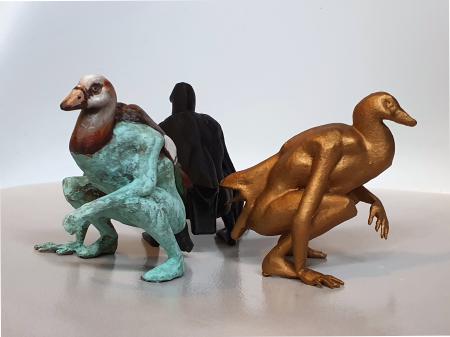
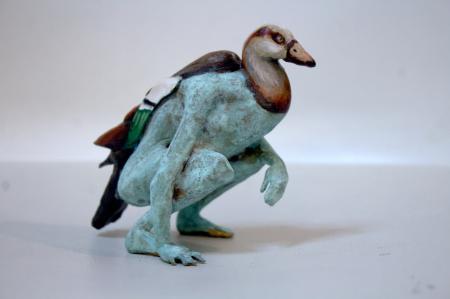
2026I am not asking for the moon City of Ottawa Art Collection Ottawa, Canada 3D printed sculptures based on ancient Egyptian artifacts.
Publications
-
2026More-than-Human Networks? Dutch Museum Collections Book inherit. heritage in transformation Pansee Abou El Atta Berlin, Germany doi.org/10.18452/34377 More-than-Human Networks? Dutch Museum Collections examines how Dutch museum practices of collecting, classifying, and displaying human remains have shaped—and constrained—historical understandings of the “human.” Tracing anatomical, medical, and colonial collecting from the early modern period to the twentieth century, the text shows how human bodies became embedded in taxonomic, economic, and metaphysical networks that linked humans, animals, objects, and environments within hierarchical worldviews. By reframing these collections as more-than-human assemblages and ethical actants, the contribution critically engages with the colonial legacies of museum knowledge and highlights ongoing questions of agency, responsibility, and restitution in heritage practice. “tbc. working through heritage concepts" is a wordbook series published by the Centre of Advanced Study “inherit. heritage in transformation". Every issue works with a key concept of heritage, its history, current state, or future transformations. "inherit" team and fellows contribute to the series, which is updated with every fellow intake. Concept-work in heritage is always in a process of tbc: “to be confirmed” (still under development, evolving) and “to be continued” (an ongoing process, part of a longer historical narrative). This series of short publications captures work-in-progress on concepts, notions, and words that are significant in the research taking place at "inherit". It gives space to experimentation, highlighting the continuous, transforming and transformative nature of heritage research.
reviews
-
2025Skeleton in the Closet Newspaper Dutch News Amsterdam, Netherlands www.dutchnews.nl/2025/06/skeleton-in-the-closet-show-asks-questions-on-colonial-objects/ (Review of an exhibition my work was in)
-
2025Wereldmuseum Amsterdam ponders space to ‘respectfully’ house human remains Newspaper The Art Newspaper Amsterdam, Netherlands www.theartnewspaper.com/2025/06/04/wereldmuseum-amsterdam-suggests-new-ways-to-respectfully-house-human-remains (Review of an exhibition my work was in)
-
2025Vuile handen maken Newspaper De Groene Amsterdammer Amsterdam, Netherlands www.groene.nl/artikel/vuile-handen-maken (Review of an exhibition my work was in)
-
2024CUAG’s ‘A Dream of Return’ showcases creative resistance through contemporary art Website The Charlatan Ottawa, Canada charlatan.ca/cuags-a-dream-of-return-showcases-creative-resistance-through-contemporary-art/ (Review of an exhibition I curated)
-
2022To be Continued: Troubling the Queer Archive at Carleton University Gallery Website Peripheral Review Ottawa, Canada www.peripheralreview.com/to-be-continued-troubling-the-queer-archive-at-carleton-university-gallery/ (Review of an exhibition my work was in)
Awards and grants
-
2022Carleton University Senate Medal for Outstanding Achievement Carleton University Ottawa, Canada Academic award for exemplary achievement for my PhD project "Unruly Appreciations: How contestation shapes the valueof Pharaonic things"
Secondary art-related activities
-
2025 - 2025Curator: Intersections, Art Museum of the Americas, Washington, DC.
-
2025 - 2025Curator: A Dream of Return, Carleton University Art Gallery, Ottawa, ON.
-
2023 - 2026Assistant Curator, Global Affairs, Ottawa.
-
2022 - --Curator: Intersections, Art Gallery of the Canadian Embassy, Washington, DC.
-
2022 - --Instructor, Representations of Ancient Egypt in Visual Culture, ARTH4809D, Carleton University, Ottawa
-
2021 - --Curator: #AMAatHome, Art Museum of the Americas, Washington, DC.
-
2019 - --Juror, City of Ottawa Arts Funding Program – Film and Video.