-
 info
info -
 info
info -
 info
info -
 info
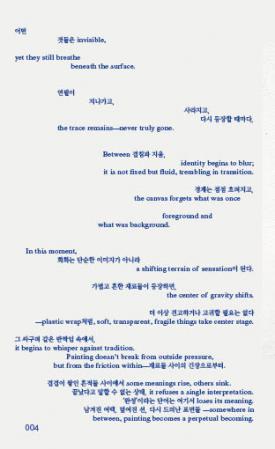
infoPlastic wrap and the Deconstruction of painting
-
 info
info -
 info
info -
 info
info -
 info
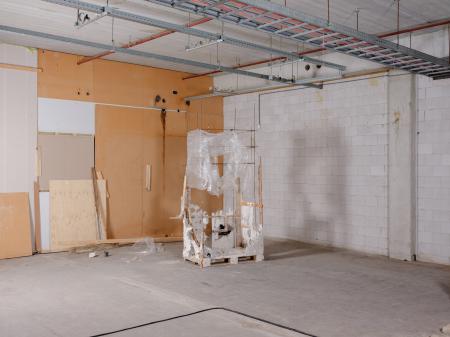
infoThis work was developed from my previous project, in which I documented a ruined house. I became interested in the trac- es of personal information inside the house that was on the verge of collapse. This led me to a political awareness: why, in a world with so many houses, are people still suffering from the lack of a place to live? At the same time, the situation in Gaza also came to my mind. All these reasons came together and led me to build a construction of a house that is simultaneously deconstructing and rebuilding. We are constantly surrounded by debris—remains of war, remains of industry, remains of emotion. The continuous process of disuse and rebuilding mirrors the way our world is endlessly renewed. This sculpture embodies that cycle: it holds both the remains of what has been lost and the beginnings of what is being formed. The destruction of productive assets directly affects people’s access to essential sources of livelihood, which in turn under- mines their capacity to survive and damages their economic position. Those who suddenly lose land, houses, cattle, and other assets are left without means to earn a living or provide food and shelter for their families. Such losses have a profound impact on the ability of affected households to recover their economic and social position in post-conflict settings.
-
 info
info -
info
This performance explores the state of human existence through the use of everyday food ingredients and kitchen tools: white radish, red sauce, a cutting board, a knife, and a plate. The work was first developed in response to the question: “How do you define your surroundings?” At the time, I had just entered a com- pletely new environment—new culture, people, language, and daily structures. What I felt most strongly was a sense of alienation. There seemed to be an invisible gap between myself, as someone who had just arrived, and the society that was already established. I noticed the constant effort required to step inside this “bubble”—to feel a sense of belonging, to build a comfort zone of emotional support, acknowledg- ment, and safety in which one can reveal their true character. I asked myself: why couldn’t I remove this isolated and alienated feeling? Was it cultural difference? The desire to be good, feelings of sym- pathy, jealousy, envy, or desire? These emotions reveal a kind of duality. They are natural to human beings, yet when they surface strongly, beyond appearances, they often become a ground for judgment—placing others as equal to, or lower than, oneself. In Korean, there is a word that directly relates to this: kkakdugi. It refers both to a type of cubed radish kimchi, and colloquially, to an “out- sider.” My performance began with this metaphor as a way to describe my own position in a new environment. But as I continue to reflect on the work, it grows beyond autobiography. It points to something more fundamental about human nature: our emotions, our patterns of living, and the double-sidedness within us all. The performance is an ongoing research into these conditions of being human.
-
info
This performance started from daily observations that I captured in drawings. These were things I could not grasp or hold physically, such as repetitive machine movements or unintended sounds. Eventually, I translated these into a physical performance.
Social media
Platform
KABK Alumni
Member of a professional association/artists’ association
KABK
Curriculum vitae
Education
-
2022 - 2025Fine Arts Den Haag, Koninklijke Academie van Beeldende Kunsten diploma
exhibitions
-
2024Somersault The hague, Netherlands We are constantly surrounded by debris—remains of war, remains of industry, remains of emotion. The continuous process of disuse and rebuilding mirrors the way our world is endlessly renewed. This sculpture embodies that cycle: it holds both the remains of what has been lost and the beginnings of what is being formed. The destruction of productive assets directly affects people’s access to essential sources of livelihood, which in turn under- mines their capacity to survive and damages their economic position. Those who suddenly lose land, houses, cattle, and other assets are left without means to earn a living or provide food and shelter for their families. Such losses have a profound impact on the ability of affected households to recover their economic and social position in post-conflict settings. Group
reviews
-
2025Magazine Park, Kyo-sun Republic of Korea
Secondary art-related activities
-
2016 - 2018Gyeonggi Arts High School, Korea
-
2013 - 2015Jeonju Arts Middle School, Korea