-
 info
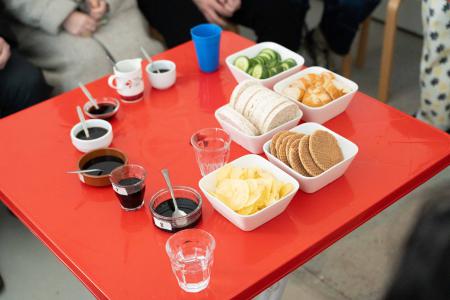
infoThrough tasting soy sauce, this workshop invites us to question how we experience and define the taste of Asia. Look, smell, and taste your way to finding the soy sauce that suits you best. Have you ever stood in front of endless shelves of soy sauce, only to end up buying the same one every time? Or wondered how soy sauce could be used in more creative ways? At our Soy Sauce Tasting Workshop, you’ll explore 8 different types of soy sauce from across Asia, but it is blind tasting! Through guided tastings, you’ll compare subtle differences in aroma and flavor, create your own soy sauce tasting notes, and cook a dish that perfectly matches the character of each soy sauce.
-
 info
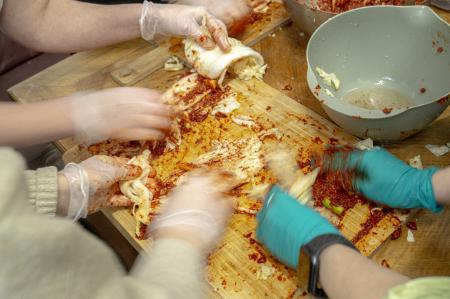
infoWe followed a kimchi recipe from the zine "Introduction to Creative Kimchi Making" written by Yun영실. *Kimjang is a Korean term for a collective practice of making kimchi together. Kimjang used to be household work for female family members. It was laborious work, but it was also about sharing women's power and showing solidarity among women back in the days. Bringing Kimjang into minormoons - what would it mean if we perform the recipe from Yun in The Hague, far away from home? Could it also be a way of solidarity? How can Kimjang be actively seen as a way of sharing knowledge? In the end, the questions are interesting, but most importantly, yes, we had a spicy mouthful journey.
-
 info
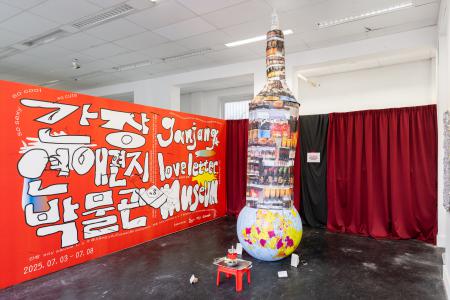
infoganjanglovelettermuseum is a museum stage, where a soy sauce plays the key role of everything. Although it has the name of museum, it is more like a temple worshiping spy sauce. Aggressive billboard of museum logo, concentrated images of soy sauce bottle on the sculpture, plastic soy sauce fountain and fake artifacts saying Dionysus was actually a god of soy sauce…How serious or joke it is, where is the line we need to believe and not to believe? At the end, everything is soy sauce.
-
info
Performed by Haeun Na [@haeun.is.drawing](https://www.instagram.com/haeun.is.drawing/?hl=ko) Jesa, as in “Jesa Café Community,” refers to a traditional Korean ritual of memorializing ancestors, which has served an important cultural function of strengthening family ties and commemoration. However, ‘Jesa’ has been pointed out as a representative example of the invisibility of women's labor in a patriarchal society. Despite the enormous amount of unpaid labor that women provide in the preparation of rituals, they have been largely excluded as the ritual's primary actors. While women's labor is an integral part of the rituals, their contributions are not explicitly represented in the rituals, creating a space of gendered inequality. The mobilized ‘Jesa’ goes on tour in three different places in Berlin, which are ‘Museuminsel’, ‘Brandenburger Tor and ‘Denkmal für die ermordeten Juden’. The performer in the video carries out a ceremony to commemorate herself, alongside her chosen venues and favorite foods-’Laugenstange’, ‘Zwetschgen’ and ‘Pom Bär ketchup flavor’. /text. Sooyeon Ahn
-
info
Performed by Haeun Na [@haeun.is.drawing](https://www.instagram.com/haeun.is.drawing/?hl=ko) Jesa, as in “Jesa Café Community,” refers to a traditional Korean ritual of memorializing ancestors, which has served an important cultural function of strengthening family ties and commemoration. However, ‘Jesa’ has been pointed out as a representative example of the invisibility of women's labor in a patriarchal society. Despite the enormous amount of unpaid labor that women provide in the preparation of rituals, they have been largely excluded as the ritual's primary actors. While women's labor is an integral part of the rituals, their contributions are not explicitly represented in the rituals, creating a space of gendered inequality. The mobilized ‘Jesa’ goes on tour in three different places in Berlin, which are ‘Museuminsel’, ‘Brandenburger Tor and ‘Denkmal für die ermordeten Juden’. The performer in the video carries out a ceremony to commemorate herself, alongside her chosen venues and favorite foods-’Laugenstange’, ‘Zwetschgen’ and ‘Pom Bär ketchup flavor’. /text. Sooyeon Ahn
-
info
Performed by Haeun Na [@haeun.is.drawing](https://www.instagram.com/haeun.is.drawing/?hl=ko) Jesa, as in “Jesa Café Community,” refers to a traditional Korean ritual of memorializing ancestors, which has served an important cultural function of strengthening family ties and commemoration. However, ‘Jesa’ has been pointed out as a representative example of the invisibility of women's labor in a patriarchal society. Despite the enormous amount of unpaid labor that women provide in the preparation of rituals, they have been largely excluded as the ritual's primary actors. While women's labor is an integral part of the rituals, their contributions are not explicitly represented in the rituals, creating a space of gendered inequality. The mobilized ‘Jesa’ goes on tour in three different places in Berlin, which are ‘Museuminsel’, ‘Brandenburger Tor and ‘Denkmal für die ermordeten Juden’. The performer in the video carries out a ceremony to commemorate herself, alongside her chosen venues and favorite foods-’Laugenstange’, ‘Zwetschgen’ and ‘Pom Bär ketchup flavor’. /text. Sooyeon Ahn
-
info
The performer Haeun Na gives a dance class to the audience how to bow dancefully to your ancestors
-
 info
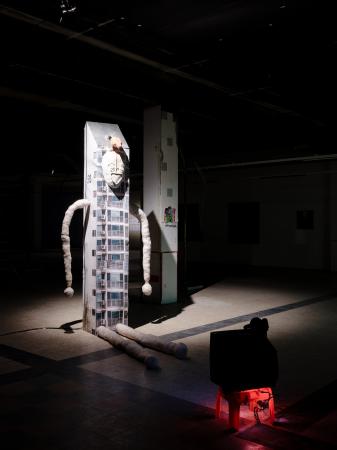
infoThe artwork 'Desire! Apartment Girl and Pigeon' combines a 3-meter-high apartment girl installation and a video. The installation is decorated with a porcelain mask and a chocolate pigeon atop. The audience enters her space, where she watches television. In Korea, apartments are the most popular type of housing. Symbolizing Korea's housing and pigeon populations, the work explores strange parallels, contrasting societal feelings: a strong love for apartments and a peculiar desire for pigeons. In collaboration with Alper Çekinmez
-
 info
info -
 info
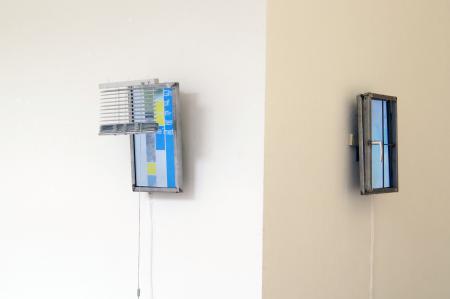
infoAm I looking inside from the window or outside of the window?
-
 info
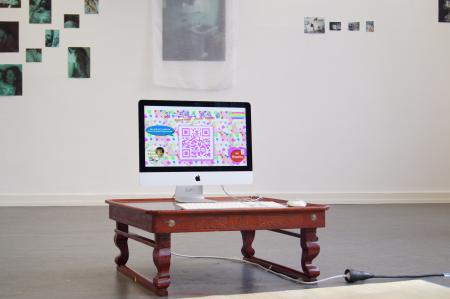
infoIn Korea, Jesa is an annual ancestral ritual in which an abundant table of food is prepared and offered to deceased ancestors. Traditionally, women are responsible for preparing these elaborate dishes. In this project, I created a web-based work around a simple concept: purchase ritual food online, and it is delivered to the ancestors through augmented reality. The work mimics online shopping—with a simple click, the ritual appears complete through the latest technology. But does ordering food through digital convenience truly fulfill the meaning of the ritual? If tradition becomes a transactional gesture mediated by technology, what remains unexamined? The project questions both the positive and problematic aspects of ritual culture. Without critical reflection on the past and present—particularly the historical and ongoing sacrifice of women's labor—can the underlying issues ever be resolved? Installation view Through this work, I ask how rituals should be understood, transformed, or challenged in contemporary society.
-
 info
infoIn Korea, Jesa is an annual ancestral ritual in which an abundant table of food is prepared and offered to deceased ancestors. Traditionally, women are responsible for preparing these elaborate dishes. In this project, I created a web-based work around a simple concept: purchase ritual food online, and it is delivered to the ancestors through augmented reality. The work mimics online shopping—with a simple click, the ritual appears complete through the latest technology. But does ordering food through digital convenience truly fulfill the meaning of the ritual? If tradition becomes a transactional gesture mediated by technology, what remains unexamined? The project questions both the positive and problematic aspects of ritual culture. Without critical reflection on the past and present—particularly the historical and ongoing sacrifice of women's labor—can the underlying issues ever be resolved? Through this work, I ask how rituals should be understood, transformed, or challenged in contemporary society.
-
 info
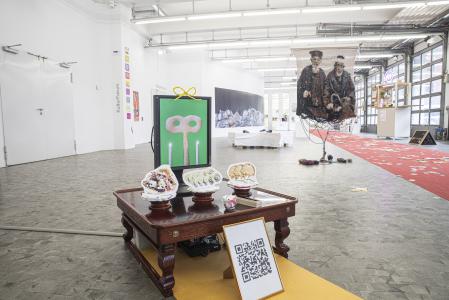
info**Post-Human Jesa** is a performance and installation that reimagines the Korean ancestral ritual Jesa in a distant future, perhaps one in which humans no longer exist. The ceremony is reconstructed through a digital alien ancestor displayed on a monitor, placed together with a traditional Korean wooden ritual table and dishware. The offerings consist of hybrid snacks such as döner, avocado sushi, and taiyaki. None of the food can be clearly identified as culturally authentic; each dish reflects a condition of mixed and entangled cultural identity. Jesa (제사) is a Korean ritual honoring deceased relatives. Shaped by Confucianism, it emphasizes filial piety and strengthens family bonds across generations. Traditionally, however, the ritual privileges male lineage. Ancestral rites center on male heirs, while women, although responsible for most of the preparation work, remain socially and symbolically marginalized during the ceremony itself. What happens if the direction of reverence shifts from the past to the far future? Instead of honoring ancestors, this work imagines honoring descendants yet to be born, beings from a distant era who may include both human and nonhuman life. Rather than reinforcing patriarchal lineage, it envisions a future beyond gender. Through humor and science fiction, **Post-Human Jesa** redirects devotion forward in time and proposes an absurd yet sincere gesture of respect and love toward future beings. It is an SF comedy that playfully and critically rethinks ritual, kinship, and intergenerational solidarity among all forms of life.
-
info
The artwork 'Desire! Apartment Girl and Pigeon' combines a 3-meter-high apartment girl installation and a video. The installation is decorated with a porcelain mask and a chocolate pigeon atop. The audience enters her space, where she watches television. In Korea, apartments are the most popular type of housing. Symbolizing Korea's housing and pigeon populations, the work explores strange parallels, contrasting societal feelings: a strong love for apartments and a peculiar desire for pigeons. In collaboration with Alper Çekinmez
-
info
**Post-Human Jesa** is a performance and installation that reimagines the Korean ancestral ritual Jesa in a distant future, perhaps one in which humans no longer exist. The ceremony is reconstructed through a digital alien ancestor displayed on a monitor, placed together with a traditional Korean wooden ritual table and dishware. The offerings consist of hybrid snacks such as döner, avocado sushi, and taiyaki. None of the food can be clearly identified as culturally authentic; each dish reflects a condition of mixed and entangled cultural identity. Jesa (제사) is a Korean ritual honoring deceased relatives. Shaped by Confucianism, it emphasizes filial piety and strengthens family bonds across generations. Traditionally, however, the ritual privileges male lineage. Ancestral rites center on male heirs, while women, although responsible for most of the preparation work, remain socially and symbolically marginalized during the ceremony itself. What happens if the direction of reverence shifts from the past to the far future? Instead of honoring ancestors, this work imagines honoring descendants yet to be born, beings from a distant era who may include both human and nonhuman life. Rather than reinforcing patriarchal lineage, it envisions a future beyond gender. Through humor and science fiction, **Post-Human Jesa** redirects devotion forward in time and proposes an absurd yet sincere gesture of respect and love toward future beings. It is an SF comedy that playfully and critically rethinks ritual, kinship, and intergenerational solidarity among all forms of life.
-
info
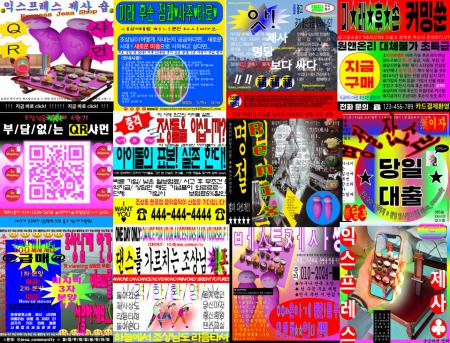
Advertisement for express jesa shop
-
") info
info*tap obeu deo woldeu is a korean phonetic spelling for Top Of The World
-
hole") info
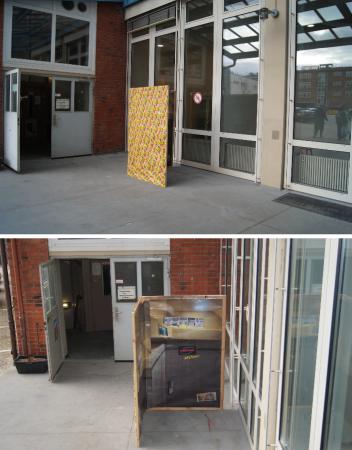
info> *Welcome to Soy Sauce Restaurant. Here, you’ll find every possibility of soy sauce, even the best in the world. No harm, with love and sincerity. Microwave OK. All you need to do is look through this-.* > Viewers can peep through the holes in the installation. Inside the present-like box, the viewer can see a mirrored image of an Asian snack bar in Germany. The peepholes on the installation have a frame made from a Windows XP browser design. The holes are tiny, which allows viewers to have only limited access to perspective.

Social media
Member of Artists’ Initiative/Collective/Incubator
minor moons
Curriculum vitae
Education
-
2023 - 2025Fine Art Bachelor Den Haag, Koninklijke Academie van Beeldende Kunsten diploma
-
2015 - 2021Ceramic and Glass art Bachelor Hongik University of Art and Design(Seoul)
exhibitions
-
2025
-
2024CASTAWAY Sexy Land Amsterdam, Netherlands Group
-
2023Reality Render vouz Stadtgalerie Kiel, Germany www.kiel.de/de/kultur_freizeit/stadtgalerie/index.php Group
-
--We were never here The Hague, Netherlands 'We were never here' is a site-specific show which took place in Space Anna in 2025 February. Group
Projects
-
2026
Soy sauce tasting workshop brad wolff project Amsterdam , Netherlands Through tasting soy sauce, this workshop invites us to question how we experience and define the taste of Asia. Look, smell, and taste your way to finding the soy sauce that suits you best. Have you ever stood in front of endless shelves of soy sauce, only to end up buying the same one every time? Or wondered how soy sauce could be used in more creative ways? At our Soy Sauce Tasting Workshop, you’ll explore 8 different types of soy sauce from across Asia, but it is blid tasting! Through guided tastings, you’ll compare subtle differences in aroma and flavor, create your own soy sauce tasting notes, and cook a dish that perfectly matches the character of each soy sauce.
-
2026
Kimjang workshop minor moons Netherlands We followed a kimchi recipe from the zine "Introduction to Creative Kimchi Making" written by Yun영실. *Kimjang is a Korean term for a collective practice of making kimchi together. Kimjang used to be household work for female family members. It was laborious work, but it was also about sharing women's power and showing solidarity among women back in the days. Bringing Kimjang into minormoons - what would it mean if we perform the recipe from Yun in The Hague, far away from home? Could it also be a way of solidarity? How can Kimjang be actively seen as a way of sharing knowledge? In the end, the questions are interesting, but most importantly, yes, we had a spicy mouthful journey.
Publications
-
2024Was ist die beste Sojasoße? Book Haeun Na The Hague , Netherlands natomtom.notion.site/Portfolio-1c341896f5e180068b5dd5b7f27472e5 Drawing from Haeun Na's personal experience as a cashier at an Asian supermarket in Germany, this book explores how soy sauce arrived in Western Europe and shares various soy sauce recipes from Korea, Japan, and Taiwan through interviews. "What is the best soy sauce?" was actually the most frequently asked question from German customers. But how do we choose the only one best? Although we say we could, what are the standards for selection and who has the power to 'select'? This is a salty zine, sharing common experiences as Asians living in Europe. How distant are we, yet alike? And most importantly, WHAT IS THE BEST SOY SAUCE?