-
info
Due to Covid-19, the KABK graduation show has been postponed until mid-september 2020. For my (online) exam in June 2020, I exhibited the 2 (sound and textile) installations of the graduation work "The 'Pages' of my Research" in the 2 windows of my home, located at the street side of the Paviljoensgracht in The Hague. This is the video I made related to these two installations and the window exhibition.
-
 info
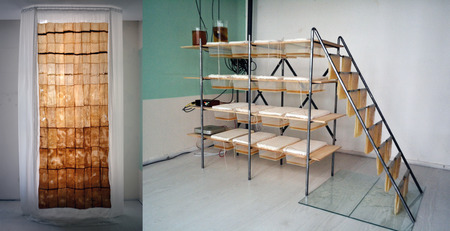
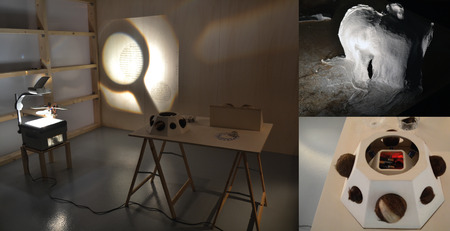
infoOne year ago, I was confronted with a material I had never seen and smelled before. The gorgeous brownish translucency of the material, the undefinable smell, the asymmetrical texture and patterns, the incredible strength yet flexibility it had, provoked strong ambivalent sensibilities. Since this cross-modal encounter, the mighty material of cellulose grown by microorganisms has been the focus of the research for my Master degree of the ArtScience Interfaculty of the Royal Academy of Arts/ Royal Conservatory of the Hague (2020). The sentence ‘What does it mean to give agency to the material, to follow the material and to act with the material?’ (Petra Lange-Berndt) has been the main inspiration for the construction of the (material) research methodology that followed. I created an experimental domestic (sound) set-up (see photos) in which I followed the growth of 16 sheets of cellulose in five consecutive iterations over a period of six months (December 2019 - May 2020) in a literal (=time) and figurative (=meaning) manner. Simultaneously to this growing process, I write, think, act, feel in the same spatial context. The result after the 5 repetitions, a total amount of 80 sheets, are 'The Pages of my Research'. The entire work consists of a (1) written work (thesis) (2) textile installation of 3 meters high with the 80 translucent sheets (photo) and (3) the experimental installation through which the (live) recordings of the fermentation are audible for the public (photo). In this manner, I hope to provoke a similar ‘multi sensorial’ experience to visitors.
-
info
In 2018, during my search for the answer what tactility in material research mean, I enjoyed a few months marathon of learning to throw the wheel (making clay pots is the most tactile experience you can have). Of course, kilos of clay I spent while learning it, recycling the failed works over and over again. One day, I became aware that when you throw the dried clay back into the bucket of water to recycle it, zillions of air bubbles pop up in the bucket. What would I hear if I would put a hydrophone (under water microphone) in that same bucket? It's exactly what I did, and the result was truly astonishing! Simultaneously, for already some years, I have an increasing interest in the concept of cybernetics (control systems, feedback loops, regulatory systems and so on). I came to the idea to combine this "sound discovery" with this interest, creating a binaural sound installation of ceramics in which the (level of the) sound controls the entire loop (the water supply & drainage). The result shown on the photo in the video was presented at Quartair Contemporary Art Initiatives in The Hague (7-9 June 2019). You are hearing three sound examples of "outbursts" in the video. The sound is without any effects, filters, or whatsoever. It's the agency of raw material and natural interactions and processes.
-
 info
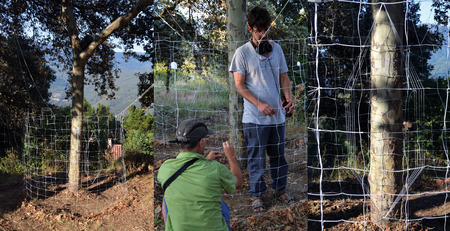
infoThe site specific work Strings & Needles has been developed, together with Birgit van der Knaap, during the last three days of the 10-day artist residency / field recording workshop Audiotalaia in the North of Spain. The concept is extremely simple; we found an agricultural farm fence and used it as a grid to create a zillion strings with different frequencies. By means of a dozen of needles that were hanging in the tree, the community that visited the final concert at the church of Santa Susanna could play together. It had become a communal instrument/harp. The sound was amplified through the placement of 2 contact mics on different places on the fence. The speaker was hidden in the tree.
-
info
I presented APP(E)A(L)LING (Appealing / Appalling) during the Graduation Show of the Rietveld Academy (Amsterdam) between the 4th and 9th of July 2018. The work is the result of the development of The Boundary of Things (2018). The main installation, containing of two silicone sculptures, has been 3 months on show during the Robot Love exhibition in the second half of 2018 (including the Dutch Design week in Eindhoven) and was selected as one of the light sculptures for the Robot Love & Glow Eindhoven.
-
 info
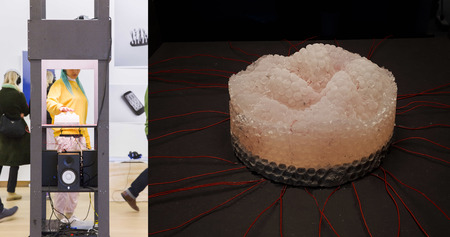
infoThe Boundary of Things contains a haptic interface that mediates light and sound. By interconnecting vision, hearing and touch, our visual world in which touch plays an inferior role is temporarily moved aside. It's an interplay among the senses in which the animate and inanimate, the static and the everlasting changing world, and the organic and inorganic are senses and questioned. The artwork therefore becomes an instrument with which to playfully search for boundaries and balance. The visitor is invited to touch with hesitation and to hesitate through touch. This installation was selected for the Uncut Rietveld "Hold me now: feel and touch in an unreal world" at the Stedelijk Museum in Amsterdam. I further developed this (sound) project for my graduation of July 2018. See the video APP(E)AL(L)ING for the results.
-
info
Experimentation of hands, fingers and their signs in plaster frames.
-
 info
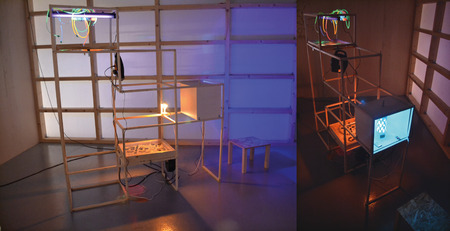
info"...Thought itself in dramatic encounters with imperceptible forces: moments when intensities provoke the mind to interpret and create." (Ramley, Deleuze and education, p. 178) This sentence was the starting point of the, (practical) research between the logical versus the illogical, reason versus emotion, the conscious mind versus the subconscious one versus the unconscious version, the known versus the unknown, the unnamable and namable. In practical form, my aim was to make an installation, or machine rather, that plays with the effects (and illusions) of our perception and deals with the different ways of conscious and not so conscious operations of our mind. In order to do so, I have used neural oscillation, the so-called brain waves categories, as point of departure for the visual (re)presentation; delta; unconscious, intuition and insight (upper) theta; sleep and dream alpha, meditation beta; activity and conversation gamma; learning and knowledge (lowest) By the means of the subjective and purely visual imagination of these 5 categories and the visual elements I have used, can I provoke and trigger with the "participant" these actual differences, doubt and confusion?
-
 info
infoThe starting point of this installation was the curiosity towards the (old) concept of the uncanny of the psychiatrist Ernst Jentsch (1906): Among all the psychical uncertainties that can become a cause for the uncanny feeling to arise, there is one in particular that is able to develop a fairly regular, powerful and very general effect: namely, doubt as to whether an apparently living being really is animate and, conversely, doubt as to whether a lifeless object may not in fact be animate – and more precisely, when this doubt only makes itself felt obscurely in one’s consciousness. The mood lasts until these doubts are resolved and then usually makes way for another kind of feeling Freud has appropriated this concept. In short, the uncanny according to him is when the familiar becomes strangely unfamiliar and when this unfamiliarity touches the core of ourselves. To say it in a Freudian way: when the repressed makes itself unconsciously known. Playing around with the border between the familiar/unfamiliar dichtomy has become one of my main interest, yet very challenging, after this project. This process of making this installation has also been the trigger for the development of my (then premature, looking back now, but maybe still underdeveloped) ideas and research towards what interactivity subjectively means in an artistic context and more specifically to my interest; the interconnection between touch and hesitation. Wanting to interact (touch), but not wanting to interact (touch) at the same time. Can I accomplish this by the means of literal human forms (inspired by the Uncanny Valley) and (dead) human material, such as hair? Provoking confusion and doubt, by the development of "weird" machines that contain human forms and material, yet that do not have a familiar form. The creation of the Hairball Machine is a good example of this thinking, taken into consideration that hair is both disgusting as well as very fluffy and therefore attractive to touch**.
-
 info
infoMultimedia installation with real crickets and one solar cricket. The real-time real sounds of the crickets was used as the basic sound of this installation. However, the movement of the crickets in their habitat provoked distortion, change of pitch, volume and reverb of the input sound.
-
info
"You can't connect the dots looking forward; you can only connect them looking backwards" (Steve Jobs) This stop motion animation connecting the dozens of cotton wools with woollen yarns became a 2 meter high fluffy sculpture.
Websites
Personal, professional website
www.liannevanroekel.comSocial media
Curriculum vitae
Education
-
2018 - 2020Master ArtScience Interfaculty Den Haag, Koninklijke Academie van Beeldende Kunsten diploma
-
2013 - 2018Interactive Design & Unstable Media Bachelor (DOGTIME) Amsterdam, Gerrit Rietveld Academie diploma
-
2012 - 2013Introduction Year Gerrit Rietveld Academie Amsterdam
-
1999 - 2000Introduction Year Artez, Arnhem
exhibitions
-
2020Graduation Show KABK 2020 Royal Academy of Arts The Hague, Netherlands During the (upcoming) KABK Graduation Show 2020 from 10 - 13 September, I will present my 2 year research The 'Pages' of my 'Research' in the form of a sound installation and a 3 meter long textile work. graduation2020.kabk.nl Group
-
2019Movement Matters: Moment of 'Ma' Faculty of Architecture and the Built Environment, Technical University of Delft Delft, Netherlands For 2 weeks, the Japanese space-time concept of 'Ma' was explored in a group setting. We presented the result in the form of a non-spoken group performance for around 30 visitors. Group
-
2019Killing Horizons Quartair Contemporary Art Initiative The Hague, Netherlands With 10 master students of the ArtScience Interfaculty of the KABK, we independently organised the group show "Killing Horizons" at Quartair Contemporary Art Initiatives. I presented the work "Dec(l)ay"; the outcome of the study related to the interaction between (dried) clay and water. The audience could participate in a ceramic sound installation in which the real time sounds of dissolving dried clay were visible and audible. www.liannevanroekel.com/declay Group
-
2018Robot Love Campina Melkfabriek Eindhoven, Netherlands ROBOT LOVE was an exciting EXPO EXPERIENCE. ROBOT LOVE presented a large-scale exhibition of contemporary art, various events, a fascinating education program, the ROBOT LOVE Academy and the ROBOT Café. From 15 September until 2 December 2018, ROBOT LOVE was bursting with impressive works by more than 50 international artists. And a varied program for young and old with many activities: workshops, lectures, debates, tours. During this period, the work APP(E)AL(L)ING was part of the Dutch Design Week and Eindhoven Glow (light festival). robotlove.nl/en/lianne-van-roekel/ Group
-
2018Graduation Show GRA 2018 Gerrit Rietveld Academie Amsterdam, Netherlands Graduation Show 2018 of the Rietveld Academy in Amsterdam. I presented the work APP(E)A(L)LING www.liannevanroekel.com/appealingappalling Group
-
2018Hold Me Now – Feel and Touch in an Unreal World Stedelijk Museum Amsterdam Amsterdam, Netherlands Rietveld Uncut is an annual exhibition and performance programme by the Gerrit Rietveld Academie. Its collaboration with Studium Generale builds up to a simultaneous conference-week and exhibition in which ‘the making and the thinking’ comes together. Departments and students have developed projects in relation to the theoretical framework of Studium Generale under the title 'Hold Me Now – Feel and Touch in an Unreal World' The exhibition took place from March 21 - 24 at Stedelijk Museum Amsterdam. holdmenow.rietveldacademie.nl/rietveld-uncut Group
Projects
-
2020
The 'Pages' of my 'Research' ArtScience KABK The Hague, Netherlands www.liannevanroekel.com/pagesofmyresearch One year ago, I was confronted with a material I had never seen and smelled before. The gorgeous brownish translucency of the material, the undefinable smell, the asymmetrical texture and patterns, the incredible strength yet flexibility it had, provoked strong ambivalent sensibilities. Since this cross-modal encounter, the mighty material of cellulose grown by microorganisms has been the focus of the research for my Master degree of the ArtScience Interfaculty of the Royal Academy of Arts/ Royal Conservatory of the Hague (2020). The sentence ‘What does it mean to give agency to the material, to follow the material and to act with the material?’ (Petra Lange-Berndt) has been the main inspiration for the construction of the (material) research methodology that followed. I created an experimental domestic (sound) set-up (see photos) in which I followed the growth of 16 sheets of cellulose in five consecutive iterations over a period of six months (December 2019 - May 2020) in a literal (=time) and figurative (=meaning) manner. Simultaneously to this growing process, I write, think, act, feel in the same spatial context. The result after the 5 repetitions, a total amount of 80 sheets, are 'The Pages of my Research'. The entire work consists of a (1) written work (a thesis), (2) textile installation of 3 meters high with the 80 translucent pages and (3) the experimental installation through which the (live) recordings of the fermentation are audible for the public. In this manner, I hope to provoke a similar ‘multi sensorial’ experience to visitors.
International exchanges/Residencies
-
2019Audiotalaia Catalonie, El Polell Montseny, Spain Audiotalaia Summer Sessions hosts a 10 days workshop / artists residency on the Catalan Countryside called Audiotalaia Summer Camp, an event thought to be a formative and educational program for young artists willing to develop their creativity from a sound perspective. www.audiotalaia.net/2019/08/summer-camp-el-polell-2019.html
Publications
-
2020APP(E)AL(L)ING Catalog Stichting Niet Normaal Patty van der Aa Eindhoven, Netherlands www.patriciajreis.com/wp-content/uploads/2019/02/robot-love-visitors-guide.pdf A haptic interface is a human-computer interaction technology that allows a human to interact with a computer through bodily sensations and movements. The interactive work APP(E)A(L)LING by Dutch artist Lianne van Roekel uses haptic interfaces to mediate light and sound. What arises from this is an interplay between the human senses with which the organic and artificial, the static and dynamic, and the animate and inanimate can be sensed and questioned. In order to discover the boundaries between these extremes and to be able to experience a different way of perceiving things, visitors are invited to both look, listen and touch.
reviews
-
2018When a love is born (between humans and robots) Website FEDERICA FONTANA Web, Italy inanimanti.com/2018/10/19/amore-umani-robot/
Awards and grants
-
2020Master ArtScience Department Award Koninklijke Academie van Beeldende Kunsten Den Haag The Hague , Netherlands Nominated and winner of the Master ArtScience Department Award (2020)
-
2018Long List Nomination for the thesis prize 2018 Gerrit Rietveld Academy Gerrit Rietveld Academie Amsterdam, Netherlands (Written by Willem van Weelden) "The 'Circular Story' is an original contribution to the field of inactive cognition theory that adopts a circular approach (Varela, Maturana) to the epistemological interrelations between the various registers (body, environment, mind) of human and machine (technology) cognition. Its originality consists of using 6 narrative positions (six fictional 'carriers') that are embedded (embodied) in real life settings, thus creating a circular, re-contextualizing effect in how these theoretical investigations can be understood. The thesis thus becomes a 'literary machine' (interface) that perpetuates this change as a living system. Beautifully designed, and with compelling diagrammatic, the thesis stands out in both originality and theoretical relevance and depth.