-
info
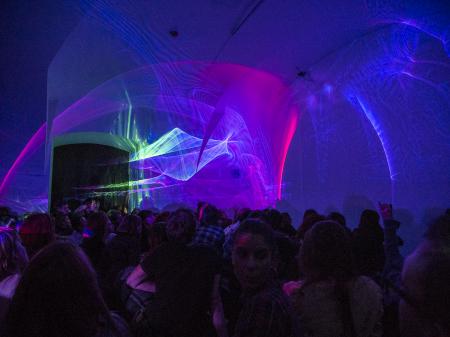
A space opera combining exotic physical phenomena with laser-projected sets and algorithmic poetry. Synopsis: Three women physicists float on the surface of a lake buried a kilometre underground — the site of a cavernous neutrino detector. While repairing one of the sensors, their boat flips over, hurling the heroines into the water aglow with neutrino-induced radiation. Arriving from a supernova 4 billion light years away, the neutrinos penetrate the lake and start blazing faster than the speed of light. This creates shimmering cones of Cherenkov radiation (the optical equivalent of a sonic boom) enveloping the submerged researchers. Descending together to the bottom of the lake in a state of telepathic euphoria, they discover why the universe is not symmetrical.
-
 info
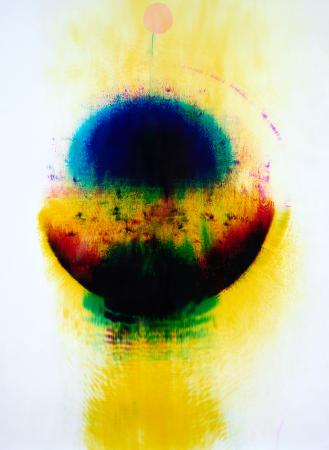
infoThe title refers to the sensation of an image or light trace lingering on the retina after the source of the image is already gone. Here, this metaphor is further enriched by the circumstances that led to the creation of this unrepeatable lasergram. It was exposed during our very first collaborative session with QuTech researchers Laurens Feije and Gerben Timmer. Our collaborators brought along a variety of custom-etched quantum optical slides, used for tuning laser beams that stimulate silicon vacancies in synthetic diamond — a technique being pioneered at QuTech for storing and processing photonic states in quantum computing and quantum internet applications. These slides are comprised of a transparent material with a nanoscopic diffraction pattern etched into its surface. Prior to exposure, as we composed this image by projecting a tightly focused laser beam through a quantum optical slide. Could a diffraction pattern, etched on a surface, curve across the edge of the slide? – such that the projected image appears “after” or beyond the confines of the diffraction grating.
-
 info
infoin collaboration with Philippe Vogelenzang
-
info
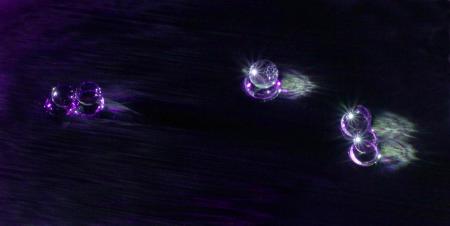
At the very end of his life quantum pioneer Werner Heisenberg asked the question, “why turbulence?” The subtle transition from smooth to turbulent flow remains among nature’s most impenetrable riddles. In Time Synthesizer, accumulative strata of microscopic hydrogen bubbles trace emerging turbulences along a flowing surface of water. Seeded in rapid succession by an electrode wire, the bubbles form time lines that vividly reveal a gamut of surface velocities across the entirety of the flow field. The bubbles are illuminated by a multi-coloured laser sheet, transforming them into prismatic lenses which expand the viewer’s depth perception. Our understanding of turbulence has been significantly elaborated since the times of Heisenberg. A pivotal insight is the concept of a hidden state of coherently patterned self-organisation, underlying the semblant disorder of turbulent flow. The minutest nuance affects every aspect of the flow and gives rise to a state of extreme sensitivity, characterized by complex spatial and temporal order. Comissioned and coproduced by Le Fresnoy Scientific advisor Jean-Marc Chomaz
-
info
Laser-lit clouds of submillimetre soap bubbles embracingly trace the air flow. This artwork was created in collaboration with the Crossing Parallels programme and physicist Fulvio Scarano at Aerospace Engineering, TU Delft. Scarano has pioneered the development of a helium-filled soap bubble system to profusely seed the air stream in large-scale wind tunnels. Enabling high-repetition rate tomographic PIV (particle image velocemitry), the system has significantly enhanced the measurement of three-dimensional velocity and vorticity, as well as aerodynamic forces and loads.
-
info
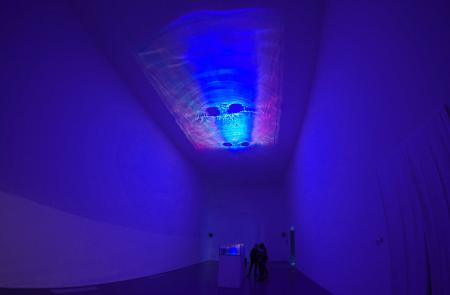
Two corotating vortices, joined together by a slender vortical bridge, drift through an enormous aquarium. Shining through the water’s surface, an expanded laser beam transforms the vortex pair into a moving lens that upwardly projects two black holes encircled by shimmering halos. Vortices may collide with one another (as in the LIGO detections), and if the “wormhole” link between them rips apart, the black holes immediately dissipate. Connecting distant black holes or two sides of the same black hole, might wormholes be an example of cosmic-scale quantum entanglement? This mind-bending conjecture of Juan Maldacena and Leonard Susskind can be traced back to two iconoclastic papers from 1935. Previously thought to be unrelated, the legendary EPR (penned by Einstein, Podolsky and Rosen) engendered the concept of quantum entanglement or “spooky action at a distance”; the second article theorised Einstein-Rosen (ER) bridges, later known as wormholes. The theory equating ER to EPR ultimately implies that the “reliable structure of space-time is due to the ghostly features of entanglement”. (Maldacena) With the generous support of LIGO, Isabel De Sena, Fulcrum Arts and the Carasso Foundation.
-
 info
infoTwo corotating vortices, joined together by a slender vortical bridge, drift through an enormous aquarium. Shining through the water’s surface, an expanded laser beam transforms the vortex pair into a moving lens that upwardly projects two black holes encircled by shimmering halos. Vortices may collide with one another (as in the LIGO detections), and if the “wormhole” link between them rips apart, the black holes immediately dissipate. Connecting distant black holes or two sides of the same black hole, might wormholes be an example of cosmic-scale quantum entanglement? This mind-bending conjecture of Juan Maldacena and Leonard Susskind can be traced back to two iconoclastic papers from 1935. Previously thought to be unrelated, the legendary EPR (penned by Einstein, Podolsky and Rosen) engendered the concept of quantum entanglement or “spooky action at a distance”; the second article theorised Einstein-Rosen (ER) bridges, later known as wormholes. The theory equating ER to EPR ultimately implies that the “reliable structure of space-time is due to the ghostly features of entanglement”. (Maldacena) With the generous support of LIGO, Isabel De Sena, Fulcrum Arts and the Carasso Foundation.
-
 info
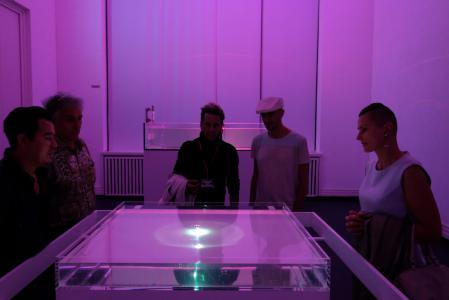
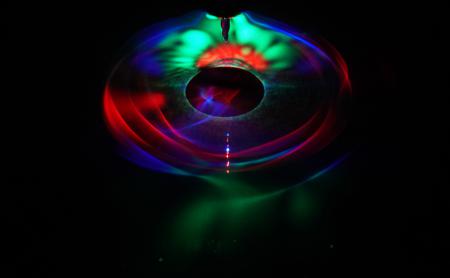
infoin collaboration with LIGO and William Basinski. A dark vortex in the middle of a water-filled basin emits prismatic bursts of rotating light. Akin to a radiant ergosphere surrounding a spinning black hole, Orbihedron evokes the relativistic as well as quantum interpretation of gravity – the reconciliation of which is essential for unraveling black hole behaviour and the origins of the cosmos. Descending into the eye of the vortex, a white laser beam reaches an impassible singularity that casts a whirling circular shadow on the basin’s floor. The singularity lies at the bottom of a dimple on the water’s surface, the crown of the vortex, which acts as a concave lens focussing the laser beam along the horizon of the “black hole” shadow. Light is seemingly swallowed by the black hole in accordance with general relativity, yet leaks out as quantum theory predicts. With the generous support of LIGO, Isabel De Sena and Fulcrum Arts.
-
 info
infoin collaboration with LIGO and William Basinski. A dark vortex in the middle of a water-filled basin emits prismatic bursts of rotating light. Akin to a radiant ergosphere surrounding a spinning black hole, Orbihedron evokes the relativistic as well as quantum interpretation of gravity – the reconciliation of which is essential for unraveling black hole behaviour and the origins of the cosmos. Descending into the eye of the vortex, a white laser beam reaches an impassible singularity that casts a whirling circular shadow on the basin’s floor. The singularity lies at the bottom of a dimple on the water’s surface, the crown of the vortex, which acts as a concave lens focussing the laser beam along the horizon of the “black hole” shadow. Light is seemingly swallowed by the black hole in accordance with general relativity, yet leaks out as quantum theory predicts. With the generous support of LIGO, Isabel De Sena and Fulcrum Arts.
-
info
Since the 1970s and 80s acoustic levitation techniques have primarily been applied by NASA and ESA to trap and navigate otherwise uncontrollable samples in microgravity. In the last two decades the same methods have also been used as a means of containerless manipulation on Earth. Numerous experiments have been performed in a vast spectrum of research areas, including fluid dynamics, analytical chemistry, atmospheric sciences, molecular biology, and most recently tabletop astrophysics. In Force Field, acoustically levitated water droplets resonate, vaporise and reassemble into spheroids, toroids and oscillating polygons while spinning nearly devoid of shear. The performance simultaneously taps into the 3-dimensionality of sound, the elusive physicality of water, as well as the rotational dynamics of celestial and subatomic bodies. This artwork was supported by Mondriaan Foundation and ENCAC residency.
-
 info
infoArising from underneath a bath of silicone oil, low frequency sound waves mobilize a pillow of air just above the liquid’s surface, preventing falling oil droplets from coalescing with the bath. As these palpitating spheroids bounce on the air-oil interface their repeated impact incites capillary waves that interlock with the waves of neighboring droplets. This close-range attractive force can result in the orbital motion of droplet pairs and clusters. During more stable modes of excitation, self-organizing geometric rafts emerge in accordance with the closest packing of spheres: the distance between droplets decreases with increasing acoustic frequency, leading to dense lattice formation.
-
 info
infoA vacuum or semi-vacuum encased within a gravity and temperature sensitive elastic skin – the scenario of an early universe, a soap bubble, and later, that of a biological membrane. By researching the behavior of soap films, a vast variety of optical, mathematical, thermodynamic and electrochemical discoveries have been made since the time of the Renaissance. One of the earliest means of analogue computing was the soap film calculator (19th century), which tackled geometric problems of minimal surface area. Soap film soft drives are currently being used for blackhole and superstring modeling. In 10000 Peacock Feathers in Foaming Acid we use laser light to scan the surfaces of nucleating and dissipating soap bubble clusters. Unlike ordinary light, the laser's focused beam is capable of crawling through the micro and nano structures within a bubble's skin. When aimed at specific angles, this penetrating light generates a large-scale projection of molecular interactions as well as mind-boggling phenomena of non-linear optics. Bubble behaviors viewed in such proximity evoke the dynamics of living cells (the lipid membranes of which, are direct chemical descendants of soap films).
-
 info
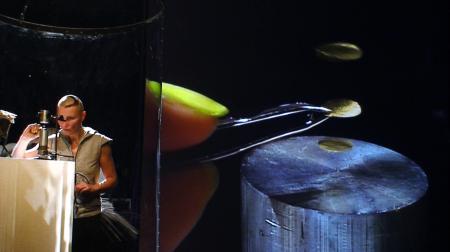
infoA 15 kHz acoustic vibration is vertically reflected at a precise distance from its source, generating a standing wave that levitates leaves of gold. The air between the intonator and the reflector is evenly divided into alternating areas of dynamic acoustic pressure and vacuous anti-nodal pockets. Within these pressureless voids, fluids and solids can be suspended and spun by the surrounding sound fields. An evocation of the weightless, frictionless environment commonly found in outer space is coupled with an extended opto-aural awareness of space-time itself: the floating objects modulate the frequency and amplitude of the standing wave that levitates them, consequently influencing one another's motion -- each part is an inseparable, co-emergent reflection of the whole.
Collaboration
Websites
personal website
portablepalace.comSocial media
Curriculum vitae
Education
-
2000 - 2001computer science New York University
-
1997 - 1999art, computer art School of Visual Arts
-
1996 - 1997philosophy Fordham University
-
1992 - 1994art history, art theory European Humanities University
-
1989 - 1994philosophy Belarussian State University diploma
exhibitions
-
2026Deep Fields Centre Wallonie Bruxelles Paris, France Exhibition at the Centre Wallonie Bruxelles aims to establish a dialogue between artists from the 1960s-1970s and contemporary approaches to the widening of the perceptive field, be they visual, auditory, mental, or aesthetic. Visual, audio, performative and cinematographic works will be displayed in an exhibition that is meant to be an aesthetic and artistic manifesto. Participating artists :Ann Veronica Janssens, Charles Ross, Claire Williams, Daniela De Paulis, Edith Dekyndt, Els Vermang, Eva L’Hoest, Evan Roth, Evelina Domnitch & Dmitry Gelfand, Félicie d’Estienne d’Orves, Heinz Mack, Hervé Charles, Ivana Franke, Jacques Perconte, Jean-Pierre Luminet, Joost Rekveld, Magali Daniaux & Cédric Pigot, Marina Gioti, Nancy Holt, Robert Irwin, Semiconductor, Stéphanie Roland. Films : Cécile Hartmann, Donald Abad, Eva L’Hoest, Francis Alÿs, Giulia Grossmann, Hervé Charles, Mathilde Lavenne, Paulius Sliaupa, Semiconductor. Performances le soir du vernissage : Evelina Domnitch & Dmitry Gelfand, Germaine Kruip, Nicolas Montgermont, RYBN. cwb.fr/agenda/exposition-collective-deep-fields Group
-
2025798 ART, SCIENCE AND TECHNOLOGY BIENNALE 2025: SYMPTOMATICA | HORIZON 798CUBE Beijing, China Art is the echo of an approaching future, where today becomes the symptoms of tomorrow. The evolution of art goes beyond a simple stylistic shift, revealing a creative process propelled by dynamic inevitability. It manifests emergent characteristics at the intersection of chance and necessity, where the deep time of art is constantly catalyzed by innovations that expand our perception of concepts, materials, technology, society and even our senses. Through their ceaseless interplay, material and immaterial, intrinsic and extrinsic elements, along with intelligence and extelligence – the external technical memory of culture – have broadened the horizons of art. The undulating horizon of this worlding world uncovers symptoms that traverse the stratified temporality of art, bringing forth new potentials in non-linear time. SYMPTOMATICA | HORIZON, presented the theme of the 798 Art, Science and Technology Biennale 2025, captures the changes of this era through the lens of 19 international artists. Their works creatively and innovatively converge art, science, and technology as a symptom of this transition. The exhibition space becomes a site of encounter with phenomena arising from the interplay of matter, machines, artifacts, and life, offering diverse perspectives on our complex yet interconnected world. Exhibited artists: Agnes Meyer-Brandis, Ane Graff, Cod.act, Dorotea Dolinšek, Evelina Dominitc and Dmitry Gelfand, Jinsu Han, Liu Wei, Maria Koshenkova, Michel Blazy, Navid Navab, Philip Beesley & Living Architecture Systems Group, Ralf Baecker, Saša Spačal, Semiconductor, ::vtol::, Wang Gongxin, Wang Jianwei, Wang Yuyang, Yang Jian. www.instagram.com/reel/DEzZByNRYO_/ Group
-
2024Beyond the Sound House of Arts Brno, France The international exhibition Beyond the Sound presents a contemporary approach to the specific and lively artistic field of sound art. Sound is presented not as an independent aesthetic form, but as a medium used to explore and reveal phenomena that are often unrecognisable to the eye. Each of the selected artists represents a different approach in the use of sound as a communication medium. The exhibition explores the ways in which sounds are created, as well as a reading of the semantic qualities that the signal chain entails. From sonifications of planetary phenomena such as fluctuations of telluric currents between the earth and the ionosphere (Ganchrow), Schumann resonances (::vtol::) or changes in the electrical potentials of cells (Interspecifics), to masterfully crafted field recordings of soundscapes at the borders of melting glaciers (Winderen), acoustic phenomena in liquid analogue computers or the gradual destruction of data memory by UV light (Moser), to the inaudible ultrasound causing the implosion of air micro-bubbles (Domnitch + Gelfand) - all the selected installations and objects are connected by their interest in innovatively exploring the world through sound and giving an ephemeral but important message about its intricate complexity and fragility of relationships. At the same time, the selected artists are also attentive to visual expression and object form and understand their work as complex, interdisciplinary and often technologically quite pioneering. www.dum-umeni.cz/en/beyond-the-sound/t9521 Group
-
2023Into the Black Hole Valkhof Museum Nijmegen, Netherlands Betreed het ruimtevoertuig, laat de zwaartekracht los en neem een duik Into the Black Hole. Zwarte gaten stellen ons bevattingsvermogen op de proef en roepen vragen op over ons eigen bestaan. Ze zijn het punt waar de wetenschap eindigt en de verbeelding begint. Into the Black Hole brengt wetenschap en hedendaagse kunst samen om je het mysterie van het zwarte gat te doen ervaren. valkhofmuseum.nl/nl/bezoek/agenda/into-the-black-hole Group
-
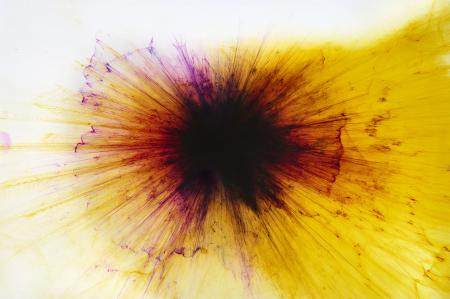
2023Lens(less)ness TU Delft Library Delft, Italy This exhibition emerged from many inquiries and experiments. First, through the lenses of QuTech physicists, plunge into the new quantum nanoworld. Then the imaging lens is removed entirely for a series of photochemical lasergrams, cameraless exposures of microscopic landscapes illuminated by lasers. For the centerpiece of this exhibition, PhD students from QuTech - Laurens Feije and Gerben Timmer - collaborated with artists Evelina Domnitch and Dmitry Gelfand to create a series of lasergrams using quantum materials. As the lasergrams depict, a focused laser beam can generate large projections that barely lose any sharpness, creating mind-boggling scales of magnification and unusual interactions between light and matter. www.tudelft.nl/evenementen/2023/library/lenslessness Group
-
2022When The Sun Is Low - The Shadows Are Long Museum of Contemporary Art Leipzig, Germany The exhibition When the Sun Is Low – the Shadows Are Long, curated by Anna Karpenko, was developed in collaboration with the Arsenal Gallery, Białystok and the Goethe-Institut Warsaw. Russia’s war of aggression against Ukraine gives the presentations in Białystok and Leipzig a special urgency. It also underlines the importance of the idea behind the exhibition, which the curator describes as follows: “The realm encompassed by Belarusian culture does not directly correspond with the geographical or political borders of Belarus. Over the centuries, it has manifested itself in an “ethic of the borderland”, as described by the Belarusian philosopher and poet Ihar Babkou. It is confined by two disparate empires, characterised by diplomatic agency in the West and aggressive power in the East. This location has entailed liminal identities, fluctuating between the “alien in the self” and the “self as alien”. These are forms of existence that do not necessarily seek out direct confrontation with oppressive structures. Rather, they tend to break away from the prevailing order and subjugation, slipping into the gaps created by this state of constant transition, where their way of thinking becomes anchored liminality. The exhibition When The Sun Is Low – The Shadows Are Long links contemporary positions of Belarusian art with two historical references. It highlights the interplay between an interest in tradition, the archaic and cosmology on the one hand, and a striving towards a pure form of modernist avant-garde on the other. The works of twenty Belarusian artists reflect various forms of resistance against repressive systems, whether they be the appropriation of ritual practices, artistic expression through amateur cosmology or the invention of a new language or a game. When the sun is low, it is unclear whether it is rising or going down.” The exhibition was presented first at Galeria Arsenal, Białystok (Poland) from 01.04.-13.05.2022. gfzk.de/en/2022/when-the-sun-is-low-the-shadows-are-long/ Group
-
2022Colliding Epistemes BOZAR Brussels, France The boundaries between science and art have been completely destabilized by the Anthropocene. Can art practices reshape the standard of today’s scientific understanding? We’re bringing together artworks that emerged from a collaborative process in which laboratories and technologies have opened up to artistic invention. The impulse for such collaborations resides in the here and now of climate breakdown and biodiversity collapse, a planetary crisis. Colliding Epistemes investigates the consequences of bringing artistic positions and scientific expertise into close proximity, exploring the friction that arises from the collision of disciplines, methodologies and mindsets. www.bozar.be/nl/kalender/colliding-epistemes Duo
-
2021Screams of the Silenced The Grey Space in the Middle The Hague, Italy thegreyspace.net/program/belarus-screams-of-the-silenced/ Group
-
20210 Starting from Zero VU ART SCIENCE gallery Amsterdam, Netherlands Although we deal with the number 0 daily, it is at the same time an invisible and elusive concept. This exhibition investigates zero – as a symbol, a concept, a number – from an interdisciplinary approach, enhancing the dialogue among art, science, technology and philosophy in line with the Vrije Universiteit Amsterdam’s interest in interdisciplinarity. www.artsciencegallery.nl/exhibition/0-starting-from-zero/ Duo
-
2020ST+ARTS Residencies Centquatre Paris, France The S+T+ARTS (Science, Technology and the ARTS) initiative, supported by the European Commission - DG CONNECT - promotes the role of artists in technological innovation projects. vertigo.starts.eu/media/uploads/ofactory_startsr_plaquette_en.pdf Group
-
2019Neuhaus Het Nieuwe Instituut Rotterdam, Netherlands Starting in the Spring of 2019, exactly 100 years after the foundation of Bauhaus, Het Nieuwe Instituut transforms into Neuhaus, a temporary transdisciplinary academy for more-than-human knowledge. For a period of four months, this ever-evolving learning environment takes over the institution, occupying and transforming its existing building and facilities, adding new ones, and opening them up - to co-create, co-own, share, and perform the Neuhaus programme of more-than-human knowledge. neuhaus.hetnieuweinstituut.nl/en Group
-
2018Black Hole: Art and Materiality from Informal to Invisible Galleria d’Arte Moderna e Contemporanea Bergamo, Italy Featuring the likes of Burri, Fontana, Tàpies, Manzoni, and Kapoor, Black Hole showcases the work of those who have explored the material element’s most intrinsic significance, where the actual concept of “matter” shatters to open up a profounder idea of “matter” as an original element, as the primordial substance that constitutes everything. www.gamec.it/en/black-hole/ Group
-
2017Limits of Knowing Martin-Gropius-Bau Berlin, Germany immersive contemporary art www.kerberverlag.com/en/1515/limits-of-knowing Group
-
2016Le vide et la lumière Le lieu unique Nantes, France retrospective www.lelieuunique.com/evenement/le-vide-et-la-lumiere/ Duo
-
2010Venice Biennial Teatro alle Tese Venice, Italy performative installation www.youtube.com/watch?v=fE8zx8domD8&t=49s Group
-
2007Camera Lucida: Sonochemical Observatory V2 Rotterdam, Netherlands Within a transparent chamber filled with water, sound waves are transformed into light emissions by employing a phenomenon known as sonoluminescence. After adapting to the absolute darkness surrounding the installation, one begins to perceive the fleeting configurations of glowing sound fields. Though it has been established that the source of light arises inside of imploding gas bubbles, the underlying energy amplification cannot be fully explained. v2.nl/events/camera-lucida Duo
Projects
-
2021
Studiotopia VU and UVA Amsterdam, Netherlands iop.uva.nl/content/news/2020/08/a-collaboration-between-art-and-science.html?cb Florian Schreck’s research on quantum clocks and ultracold atoms has been selected as one of 13 projects to be featured in the Studiotopia initiative for collaborations between art and science. For a period of 17 months, artists Dmitry Gelfand and Evelina Domnitch will collaborate with Schreck in a residency programme aimed towards sustainable development.
Commissions
-
2020Time Synthesizer Le Fresnoy studio des arts contemporains Tourcoing, France At the very end of his life quantum pioneer Werner Heisenberg asked the question, “why turbulence?” The subtle transition from smooth to turbulent flow remains among nature’s most impenetrable riddles. In Time Synthesizer, accumulative strata of microscopic hydrogen bubbles trace emerging turbulences along a flowing surface of water. Seeded in rapid succession by an electrode wire, the bubbles form time lines that vividly reveal a gamut of surface velocities across the entirety of the flow field. The bubbles are illuminated by a multicoloured laser sheet, transforming them into prismatic lenses which expand the viewer’s depth perception. www.lefresnoy.net/fr/Le-Fresnoy/production/2020/installation/1294/time-synthesizer finished
Sales/Works in collections
-
2024Afterimage TU Delft Delft, Nederland Unique photochemical lasergram print
-
2023Orbihedron New Art Foundation Barcelona, Spanje Installation
-
2020ER=EPR rayograms Witteveen+Bos Deventer, Nederland 2 cameraless rayographic prints made from the installation ER=EPR
-
2019ER=EPR rayogram Galleria d’Arte Moderna e Contemporanea Bergamo, Italië Cameraless rayographic print made from the installation ER=EPR
Publications
-
2025Conjuring the Void The Art of Black Holes Book MIT Press Lynn Gamwell United States mitpress.mit.edu/9780262049962/conjuring-the-void/ An evocative and richly illustrated exploration of modern art about black holes. Inescapable and mysterious, black holes have long captured the imagination of visual artists, even before their existence was first confirmed in 1971. In Conjuring the Void, Lynn Gamwell explores this fascinating intersection of art and science. Starting with a chronological description of key developments in the science of black holes, Gamwell builds a foundation for the reader through visualizations of black holes created by scientists, depicting how a black hole’s extreme gravity affects visible objects in its vicinity. From there, the book explores how artists have addressed the challenge of visualizing black holes by developing new methods of working with diverse materials, including a black paint that absorbs 99.96% of visible light. Gamwell looks at how certain themes within the science of black holes—nothingness, emptiness, darkness, void, silence—are prominent in traditional Eastern thought traditions as well as in modern abstract art. She also considers the work of contemporary artists such as Anish Kapoor, Olafur Eliasson, Takashi Murakami, and Danh Vō, and discusses how they have explored these themes and more in their artworks. The book concludes with a look forward, describing dramatic developments in the imagery of black holes and their changing influence on visual culture.
Awards and grants
-
2019Witteveen+Bos Art+Technology Award Witteveen + Bosprijs Deventer, Netherlands De Witteveen+Bos-prijs voor Kunst+Techniek werd in 2001 ingesteld bij het 55-jarig bestaan van Witteveen+Bos. De prijs is bestemd voor een beeldend kunstenaar, die in zijn/haar werk de disciplines kunst en techniek op een bijzondere manier verenigt en voor wie techniek dus veel meer is dan een instrument. Een onafhankelijke jury kent de prijs toe en de prijsuitreiking wordt jaarlijks toegekend. Omdat de jury bestaat uit ter zake kundigen, die vanuit verschillende disciplines actief zijn binnen de kunstwereld en daarin over een uitgebreid netwerk beschikken, selecteert en bezoekt zij zelf geschikte kandidaten voor de prijs. Het is niet mogelijk om potentiële kandidaten voor de prijs ergens aan te melden. De Kunst+Techniek-prijs bestaat uit een bedrag van vijftienduizend euro, een publicatie in boekvorm over het werk van de bekroonde kunstenaar en de opdracht voor een nieuw te ontwikkelen kunstwerk voor Witteveen+Bos.
Secondary art-related activities
-
2019 - 2020Guest mentor, Le Fresnoy Studio national des arts contemporains
-
2011 - 2017Guest teacher, ArtScience, KABK