-
 info
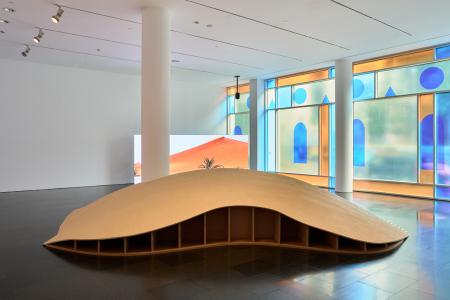
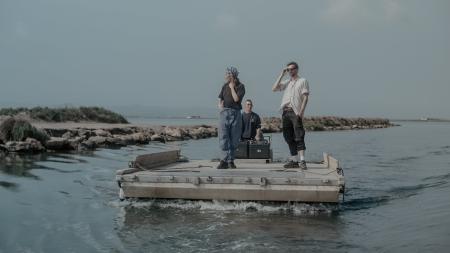
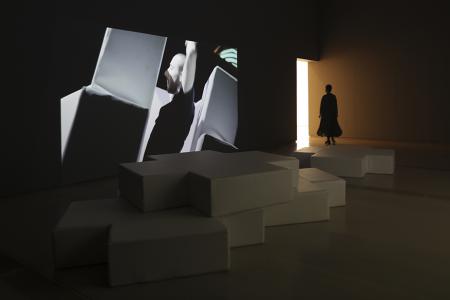
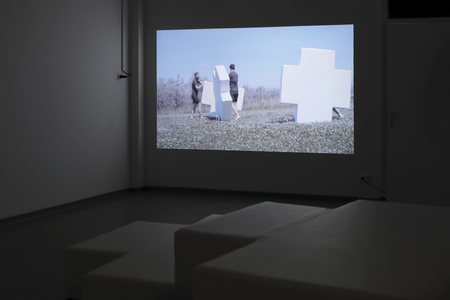
infoThe exhibition The Third Torsion presents recent works by Anna Moreno that reflect on temporality through utopian architecture and the potential of speculative imagination. The central piece is The Terminal Beach, part of a trilogy that contraposes projects by Ricardo Bofill with short stories by James Graham Ballard. The Terminal Beach, a film co-directed with Brazilian filmmaker Bernardo Zanotta, documents -in the form of a road movie- the current state of a nomadic settlement built in 1979 by Ricardo Bofill in the Algerian Sahara, commissioned by President Houari Boumédienne. The construction belongs to the architect’s utopian period, when his studio, Ricardo Bofill Taller de Arquitectura (RBTA), operated as an amalgam of architects, poets, painters, and other creators. What was intended to be a complex conceived alongside modernist principles remained unfinished, and today reveals the tension between the dream of that era and the reality of modern colonial legacies. The trilogy has received support from Amarte Fonds, Mondriaan Fonds, Stroom Den Haag, VEGAP, Hangar, and Ricardo Bofill Taller de Arquitectura.
-
info
This video excerpt corresponds to the first phase of an ongoing project developed during Anna Moreno’s residency at Pivô Arte e Pesquisa, focused on the Copan building in São Paulo. Anna Moreno’s practice departs from architectural structures, buildings, and urban systems to arrive at an audiovisual production in which fiction and reality coexist. Rather than working from a distant or external viewpoint, she immerses herself in the spaces where she films, experiences their everyday rhythms, and works from an exercise of attentive listening. The images are recorded from within the situation itself, and the editing process becomes a key space where meaning is constructed. At Copan, Anna focused on what cannot be immediately seen. She looked for stories told by its inhabitants about apparitions, ghosts, and unexplained events. Some of these accounts are narrated as personal experiences, while others point to the effects of rising rents and displacement linked to the gentrification of downtown São Paulo. These stories coexist without being resolved, allowing the building to appear as a space where memory, speculation, and lived experience overlap. The Copan building, a brutalist mega-structure from 1966 by Oscar Niemeyer, is also the site where this first phase of the research took performative form during Pivô’s open studios. The performance Psiu: Invocação, developed with musician Flávio Lazzarin, used live video and percussion to activate the space, extending the investigation into sound, rhythm, and presence. The project unfolds in two parts. This excerpt focuses on Copan. The second part, currently in progress, shifts the research to Salvador de Bahia and to another architectural context shaped by modernity and transformation: the Ladeira da Misericórdia and the Casa Coaty, a project by Lina Bo Bardi and Lelé from the 1980s, currently in renovation awaiting to be a new location for Pivô. Across both locations, the work approaches architecture as a field of illusions, where what appears is inseparable from what escapes perception, and where what seems solid can dissolve upon closer attention.
-
 info
infoMarfantes is set in the Ebro Delta in 2099, in a community that has already adapted to the rising sea levels, salinization, and subsidence that today are still on the horizon. At the centre of the piece, a group of itinerant troubadours sets up an open-air cinema on a mussel platform and screens a documentary from 2024 in which people of our time debate solutions to save the Delta. The audience watches from the future, and handles the footage as an archaeological artefact: a record of good intentions measured against what actually came to pass. Around that cinema, other scenes unfold. A communal paella is cooked with salt-resistant rice and blue crab, once invasive and now folkloric. A horseman rides into the water on fields whose soil, sunk by subsidence, no longer bears agricultural machinery. Teenagers play La Morra. A young singer performs a rondalla from that same future. The marfantes, ghostly figures rooted in Andalusi Arabic and surviving in Delta folklore, return as hauntological witnesses of a future that could have been otherwise. The work was developed over nearly five years of collaboration with farmers, fishers, teenagers, activists, and scientists from the Delta. The shoot unfolded through open situations rather than a written script, and every person on screen is an inhabitant of the territory playing a speculative version of themselves seventy-five years forward. Post-production, carried out with editor Mònica Cambra and supported by Fundación Daniel y Nina Carasso, extended this method into a series of collective editing sessions held in rice warehouses, bird-protection NGOs, and marine research labs across the Delta. Participants viewed, argued, mapped, and renamed a submerged version of their own territory, and their vocabulary has fed the final cut. Authorship, in this project, keeps circulating. The installation is composed of three synchronised channels with site-responsive spatialised sound designed by Oriol Campi, over an original score by Malaysian visual anthropologist Weiyan Low. Sound is treated as a spatial field emerging from all three screens, and the arrangement of the channels is conceived to be reconfigured each time the work is shown,.
-
info
See ep 1
-
 info
info -
info
-
 info
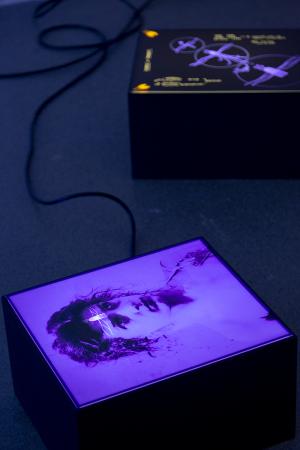
infoIn Three Ways to Measure Tides, Moreno presents two overlapping layers of the Ebro Delta: one submerged, the other emergent. Based on scientific projections, these images of the future explore how the landscape and its inhabitants might reorganize in response to rising sea levels and territorial transformation. Using fictional representations of the landscape, the artist questions the perception of geological time and its impact on daily life, drawing a parallel between the fluctuation of tides and the volatility of economic and social systems. The Ebro Delta is an ever-changing landscape, shaped by the forces of sedimentation, erosion, and rising sea levels. Three Ways to Measure Tides presents three speculative attitudes toward the future—adaptation, acceptance, and resistance—through the lens of the region’s species. The invasive blue crab, thriving in altered conditions, symbolizes adaptation. The nearly extinct Nacra, unable to adjust to environmental changes, represents resistance. The newly developed salt-resistant rice, an engineered response to salinization, embodies acceptance. Using illuminated imagery and vernacular symbolism, the work reimagines how both ecosystems and human communities negotiate transformation, drawing a parallel between biological survival strategies and political decision-making in the face of climate change.
-
info
The Terminal Beach is an essayistic road movie and the final chapter of Anna Moreno’s long-term trilogy The Terminal Beach. Filmed in the Algerian Sahara in collaboration with Bernardo Zanotta, the film returns to the remains of the Houari Boumedienne Agricultural Village (1978–79), a socialist settlement designed by Ricardo Bofill and his Taller de Arquitectura. Conceived as a model for nomadic modern life, the village was only partially built and remains inhabited today. Moving between travelogue, essay film, and speculative narration, The Terminal Beach treats the desert not as an empty landscape but as a dense archive of unfinished futures. Architecture appears as both setting and protagonist, a structure that once embodied internationalist optimism and now persists through maintenance, adaptation, and everyday life. Drawing methodologically on the writings of J. G. Ballard, the film unfolds in a suspended temporality where past promises and present conditions overlap, producing what Moreno approaches as an archaeology of the future. Through observational sequences, staged situations, voice-over, and an immersive soundscape, the film reflects on postcolonial modernity, failed utopias, and the afterlives of architectural ideology. The Terminal Beach closes The Terminal Beach trilogy by shifting from reenactment and systems analysis toward post-life, from the utopian script to the ways people continue to inhabit what remains.
-
info
-
") info
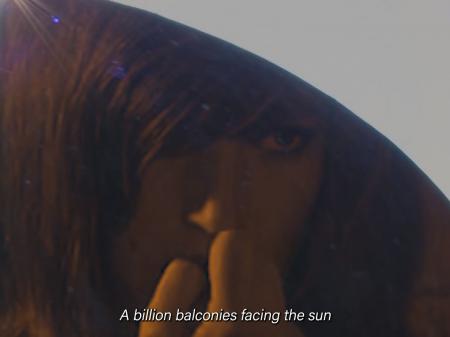
infoThe video was filmed in Costa Paradiso, a holiday resort in the northern coast of the island of Sardinia, a tiny village and holiday hub first founded in the 1970s as a VIP exclusive holiday spot once inhabited by filmmaker Michelangelo Antonioni. Antonioni and actress Monica Vitti lived in the iconic house nicknamed as La Cupola, a concrete dome designed by architect Dante Bini. Later, Costa Paradiso became one of the most renowned – and less exclusive – beach destinations in north Sardinia during the off-season. The footage includes scenes from the derelict military base on the small island of Caprera, from La Maddalena archipelago, also in northern Sardinia, where Garibaldi had its base. The skewed and fragmented narrative takes us on a fictional detour a sort of ghostly figure inspired by the actress Monica Vitti, lover of Michelangelo Antonioni, with whom she lived in La Cupola during the shooting of Il Deserto Rosso (1964). This film is also referenced in the video through borrowing some of its industrial sounds and the myth of the singing voice.
-
info
-
 info
infohttps://vimeo.com/annamoreno/costaparaiso
-
info
PASSWORD: BLDZEN PASSWORD: BLDZEN Bulldozer is a single take continuous zoom that takes us through a secret meeting between a real estate tycoon and a corrupt politician at a beachfront hotel where they celebrate the success of one of their shady deals. What starts as a game between power and money with clear sexual undertones, soon lays bare the real intentions behind their encounter. The politician has sold the businesswoman to save himself at the brink of an anti-corruption investigation and invites her to disappear. As the tension escalates and the zoom tightens its frame, we understand that their attraction is inseparable from the danger they represent to one another.
-
 info
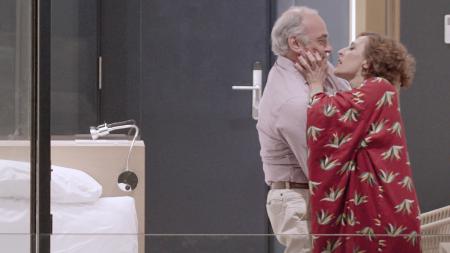
infoBulldozer is a single take continuous zoom that takes us through a secret meeting between a real estate tycoon and a corrupt politician at a beachfront hotel where they celebrate the success of one of their shady deals. What starts as a game between power and money with clear sexual undertones, soon lays bare the real intentions behind their encounter. The politician has sold the businesswoman to save himself at the brink of an anti-corruption investigation and invites her to disappear. As the tension escalates and the zoom tightens its frame, we understand that their attraction is inseparable from the danger they represent to one another.
-
 info
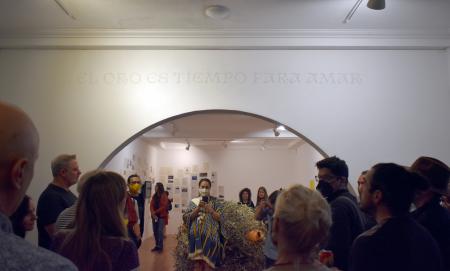
info"Time is gold" is a phrase shared by all Spanish speakers that has taken on a more funereal relevance in contemporary society, globalized and open 24 hours a day. By inverting the factors of this phrase, it is gold that becomes time, a symbol of the colonial extractivism that contributed to the birth of globalization. Today, extractivist policies linked to environmental agreements are just another face of an economy based on outsourcing. This sentence has been scratched on the walls of several Spanish Cultural Centers in Latin America, part of an ongoing traveling show "Fabular un Mundo Diferente", curated by Blanca de la Torre, which tries to symbolically reach zero CO2 emissions. An employee of the institution has invested their physical and temporal resources to scratch this phrase on the wall, extracting in turn the physical matter that builds it. Moreno received only a photograph of the completed sentence by e-mail. According to our calculations, the detached dust shown here should approximate 50g, equivalent to the carbon footprint of sending an e-mail with attached image. The phrase scratched on the wall Gold is time to love is taken from an unrealized utopian project by the Spanish architect Ricardo Bofill called The City in Space (1970). The phrase appeared on the floor plan of the projected houses, where the furniture disappeared, replaced by disappeared, replacing it with terms and phrases that proposed a new urban growth based on demand and not on predetermined plans.
-
info
-
 info
infoAnna Moreno’s Plastic, Marble, and Helicopters renders 1970s utopian architecture into a speculative myth, flung at us from an atemporal, near future. It is the culmination of a year-long research into Global Tools, a pioneering pedagogical project initiated in 1972 by various architecture studios from the Italian radical design movement led by Ettore Sottsass. Global Tools proclaimed the “re-founding of manual labor,” and the use of “poor technique” and “simple technology” while invoking the body as the ultimate form of architecture, a site with hidden political and creative potential. Sottsass was then the artistic director of Poltronova, a high-end furniture firm, and research center that still produces some of Global Tools’s members’ iconic designs. The irony of the pro-Marxist group’s coziness with the luxury furniture market does not escape Moreno’s eye. With support from Poltronova, Moreno produced a four-piece modular sofa, which she used as a performative prop at the Space Electronic club during its 50th-anniversary event. The Florentine discotheque was the underground hub where Global Tools enacted some of its seminal experiments. Rather than reenacting these experiments, Moreno’s performances thoughtfully re-propose them. Project made with the support of Fundación Botín (Santander, Spain) Centro Studi Poltronova (Florence, Italy) Stichting Stokroos (Utrecht, The Netherlands)
-
 info
infoAnna Moreno’s Plastic, Marble, and Helicopters renders 1970s utopian architecture into a speculative myth, flung at us from an atemporal, near future. It is the culmination of a year-long research into Global Tools, a pioneering pedagogical project initiated in 1972 by various architecture studios from the Italian radical design movement led by Ettore Sottsass. Global Tools proclaimed the “re-founding of manual labor,” and the use of “poor technique” and “simple technology” while invoking the body as the ultimate form of architecture, a site with hidden political and creative potential. Sottsass was then the artistic director of Poltronova, a high-end furniture firm, and research center that still produces some of Global Tools’s members’ iconic designs. The irony of the pro-Marxist group’s coziness with the luxury furniture market does not escape Moreno’s eye. With support from Poltronova, Moreno produced a four-piece modular sofa, which she used as a performative prop at the Space Electronic club during its 50th-anniversary event. The Florentine discotheque was the underground hub where Global Tools enacted some of its seminal experiments. Rather than reenacting these experiments, Moreno’s performances thoughtfully re-propose them. Project made with the support of Fundación Botín (Santander, Spain) Centro Studi Poltronova (Florence, Italy) Stichting Stokroos (Utrecht, The Netherlands)
-
 info
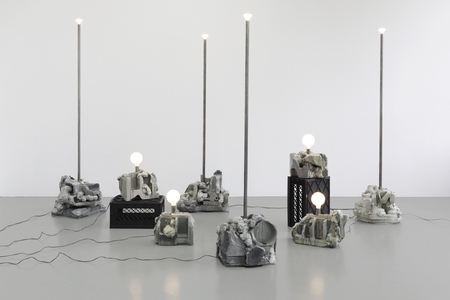
infoSeries of lamps made for the project Plastic, Marble, and Helicopters
-
info
-
info
-
 info
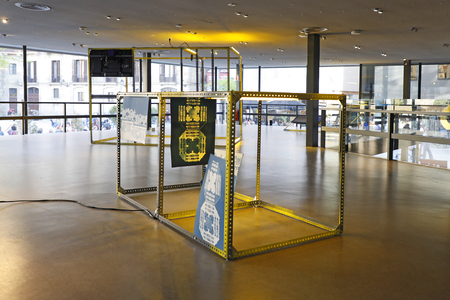
info2-channel video-installation BILLENNIUM is the result of a research into the modular architecture proposed by Ricardo Bofill’s Taller de Arquitectura during the seventies, combined with the literature by British sci-fi author J.G. Ballard. In 1962, Ballard wrote Billennium, which describes the claustrophobia and paralysis in an overpopulated world. Departing from this scenario, an expert in community-based economy and a Bitcoin evangelist speculate on a post- apocalyptic future in which honey, rather than gold or oil, act as the main currency. BILLENNIUM focuses on the line between utopian and dystopian projects, not only in architecture but also in the great narratives that we project, as a society, towards the future. This balancing posture is repeated throughout the installation, supported by Mecalux structures based on studies of the building Walden 7, designed by Bofill in 1975, and an incursion into a massive hydroponics plant. The Mecalux structures feature two screens: a video shot in the building Walden7, built by Ricardo Bofill in 1975 near Barcelona, and a video shot inside a massive hydroponics plant in The Hague. The hanging blueprints are based on original drawings of Walden7 from Bofill’s own archive. The installation includes vaporwave music composed by Siem Beets and an audioguide featuring the speculations of the two economy experts. The Architects Association of Catalonia hosts this video-installation which takes place within the framework of Beehave, a project by the Miró Foundation in Barcelona.
-
 info
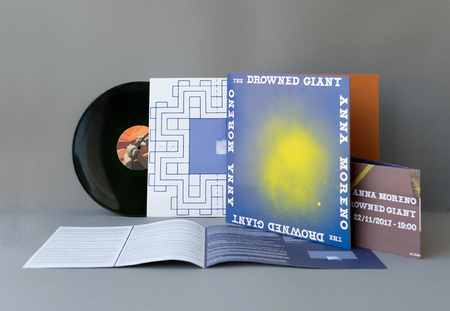
infoIn 1970 a happening was organized in Moratalaz (Madrid) to promote the utopian housing project The City in Space, by the Spanish architect Ricardo Bofill (Ricardo Bofill Taller de Arquitectura). That unofficial event was never documented and ultimately the housing project was never built. In June 2017 Anna Moreno reenacted the happening in the same place as the original, and documented both the event and the research process through sound. These recordings have been released on a limited edition LP, which is now on show in the Ondertussen space, containing the testimonies of the architects, musicians and direct witnesses involved in the 1970 event. The edition also includes a booklet with fictional stories written by the architects Paula Currás & Havi Navarro, the curator María Montero, the blues expert Ramon del Solo and Anna Moreno herself.
-
") info
infoIn 1970 a happening was organized in Moratalaz (Madrid) to promote the utopian housing project The City in Space, by the Spanish architect Ricardo Bofill (Ricardo Bofill Taller de Arquitectura). That unofficial event was never documented and ultimately the housing project was never built. In June 2017 Anna Moreno reenacted the happening in the same place as the original, and documented both the event and the research process through sound.
-
 info
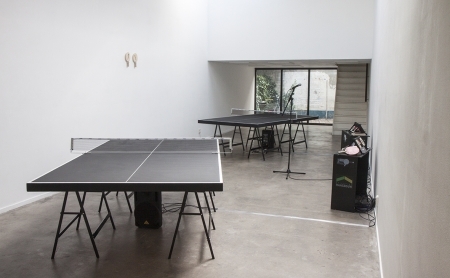
infoFirst public presentation:1646, The Hague, June 2015 An Awkward Game is a week long event on the intersection between table tennis and politics. Consisting of a series of public events and an installation on the political origins of the game. The origins of table tennis are aligned with geopolitics: British aristocrat Ivor Montagu set the rules of the game in the 30s, as he believed it could help spread Communism over the world. He became a Soviet spy, befriending Trotsky, Chaplin and producing Hitchcock’s early films. When Mao established the game as China’s national sport it became a vital cog in his foreign policy, reaching its peak with the reestablishment of US-China relations through the exchange of table tennis players in 1971. In this project, I parallel diplomacy to dialogics, a term coined by Bakhtin also in the 30s meant to note how readers become engaged in a story by nonlinear processes, and that is currently used in social sciences , stressing how dialogue itself enables the existence of ‘the other’.
-
info
Websites
Personal website
www.annamoreno.netSocial media
Member of a professional association/artists’ association
Catalan Association of Artists
Curriculum vitae
Education
-
2019 - 2020Residency Maastricht, Jan van Eyck Academie
-
2008 - 2010MA in Artistic Production & Research University of Barcelona diploma
-
2002 - 2007BA in Fine Arts University of Barcelona diploma
exhibitions
-
2026Anna Moreno. The Third Twist MACBA Barcelona, Spain The exhibition The Third Torsion presents recent works by Anna Moreno that reflect on temporality through utopian architecture and the potential of speculative imagination. The central piece is The Terminal Beach, part of a trilogy that contraposes projects by Ricardo Bofill with short stories by James Graham Ballard. The Terminal Beach, a film co-directed with Brazilian filmmaker Bernardo Zanotta, documents -in the form of a road movie- the current state of a nomadic settlement built in 1979 by Ricardo Bofill in the Algerian Sahara, commissioned by President Houari Boumédienne. The construction belongs to the architect’s utopian period, when his studio, Ricardo Bofill Taller de Arquitectura (RBTA), operated as an amalgam of architects, poets, painters, and other creators. What was intended to be a complex conceived alongside modernist principles remained unfinished, and today reveals the tension between the dream of that era and the reality of modern colonial legacies. The trilogy has received support from Amarte Fonds, Mondriaan Fonds, Stroom Den Haag, VEGAP, Hangar, and Ricardo Bofill Taller de Arquitectura. www.macba.cat/en/exhibitions/anna-moreno-the-third-twist/ Solo
-
2026Wild Waters: Dammen en delta’s na het modernisme Framer Framed Amsterdam, Netherlands The Dutch landscape is interwoven with water: a vast network of rivers, canals, aquifers and engineered waterways flowing above and beneath the ground. For centuries, inland water has been both a source of life and a persistent threat to Dutch society. In response, engineers constructed dikes, canals and storm surge barriers to protect land that lies below sea level. These infrastructures produced not only safety, but also a national mythology of mastery over a resource that doesn’t always flow in such abundance. During the era of global modernisation, dams and river engineering came to symbolise technological progress and national development. The Aswan High Dam, completed in 1970 under Gamal Abdel Nasser, brought hydroelectric power to thousands of Egyptians and transformed the Nile into an emblem of postcolonial ambition. Yet such projects have often been accompanied by displacement, ecological damage and the erasure of histories. In neighbouring Libya, the canalisation of wells enabled Italian colonial authorities to control access to water as a mechanism of dispossession, while the later abandonment of infrastructure contributed to the catastrophic floods in Derna in 2023. In occupied Palestine, the Zionist project framed through the idea of “making the desert bloom” was predicated on the extraction and redirection of underground waterways tied to longstanding traditions, agricultural practices and oral histories. The exhibition Wild Waters traces the entanglements between water, colonial expansion and territorial exploitation through works by artists Jumana Emil Abboud, Suzette Bousema, Ewa Ciepielewska & Agnieszka Brzeżańska, Giovanni Giaretta, Adelita Husni-Bey, Anna Moreno, Suat Öğüt, Eunice Pais, Ashfika Rahman, Morteza Soorani, and Abdo Zin Eldin. framerframed.nl/en/exposities/wild-waters/ Group
-
2025Bash na Bash HAUS Barcelona, Spain Based on long-term research on the Delta del Ebro, the largest wetland in the Mediterranean and a region marked by climate emergency, ‘Bash na Bash’ explores how the crossover between local traditions, youth and speculation can generate narratives of adaptation. Through video, sound and visual mapping, Anna Moreno imagines how the vernacular tends to transform itself to face future challenges. barproject.net/?p=11798 Solo
-
2025Poetry has just begun. 50 years of the Miró Foundation Fundacio Joan Miro Barcelona The exhibition provides a multifaceted history that is open to interpretation, in which the keys that motivated the setting up of the Centre for Contemporary Art Studies (CEAC) are revisited. It will explore the circumstances and the people who promoted modernity in Catalonia, with a particular emphasis on the figure of Joan Prats, who was crucial to the creation of the Fundació Joan Miró - CEAC. It will also reflect on the impact of the Spanish Civil War and the Franco regime, as well as the desire to recover the ideals of the modern movement of the 1920s and 1930s. The exhibition will cover key moments in the Fundació's history, such as the 75th anniversary of Joan Miró, the exhibitions dedicated to the artist in Barcelona in 1968 and 1969, and the construction of the building designed by Sert. This will be followed by a room dedicated to the early years of CEAC until Miró's death in 1983. The visit will continue with the transformation of the Fundació from the 1980s onwards, highlighting the enlargement of the building and the changes brought about by the Barcelona Olympic Games as key elements. Finally, the exhibition will culminate in a tribute to the artists who have been part of the Fundació's recent history, emphasising their creative processes. Since January 2026, the exhibition has showcased original works from the Foundation's own collection, featuring a selection of artworks by Joan Miró and other artists such as Joan Brossa and Claes Oldenburg, adding new layers of interpretation to the Foundation's history and providing a broader context of creation and experimentation. Artists who have contributed to the space design and conceptualisation: Lúa Coderch, Anna Moreno, Àngels Ribé and Antonio Ortega Artists participating in the artistic mediation space: Ariadna Guiteras, Enric Farrés Duran, Dani Montlleó and Lola Lasurt www.fmirobcn.org/en/exhibitions/5830/poetry-has-just-begun-50-years-of-the-miro Group
-
2023Solo booth with Joey Ramone (NL) and House of Chappaz (ES) Art Brussels Brussels, Belgium SOLO booth with Joey Ramone (Rotterdam) and House of Chappaz (Valencia/Barcelona). I present pieces in the form of a shared booth between the two galleries in my first ever solo presentation at an art fair. www.artbrussels.com/en/ Solo
-
2023Strobe Surface Joey Ramone Gallery Rotterdam, Netherlands First solo exhibition as an artist from the gallery www.joeyramone.nl/artists/AnnaMoreno/index.html Solo
-
2023Strobe Surface House of Chappaz Barcelona, Spain First solo exhibition as an artist from the gallery houseofchappaz.com/en/artist/73 Solo
-
2020Overview Effect MOCAB Beograd, Serbia and Montenegro The term Overview Effect was coined by Frank White in 1987 to describe the cognitive shift reported by a number of astronauts on having looked back from Space at their home planet Earth. The question is, do we need such a distant point of view of the planet we occupy, as a “crew of the Spaceship Earth” to use Buckminster Fuller’s metaphor, to realize that this “spaceship” is slowly running out of “fuel” and that the crew is in need of “oxygen”? This project seeks to address the issue of the environmental justice that can only be approached through an analysis of the inseparable links between climate change and other forms of injustice related to gender, race, corporate imperialism, indigenous sovereignty, and the importance of decolonising and de-anthropocentrizing the planet in order to reshape an inclusive mindset akin to a multispecies world. eng.msub.org.rs/overview-effect Group
-
2018Beehave Joan Miró Foundation Barcelona, Spain Where are the bees? The mass disappearance of honey bees in recent years has elicited a growing interest in urban beekeeping as a way to re-naturalise cities. The Beehave exhibition project curated by Martina Millà draws on this debate - also among contemporary artists - presenting installations and pieces in a range of different media by local and international artists who invite visitors to engage in sensorial experiences focused on a variety of aspects of the world of bees. The Beehave project features works by the artists Joan Bennàssar, Luis Bisbe, Alfonso Borragán, Joana Cera, Gemma Draper, GOIG (Pol Esteve & Miquel Mariné) & Max Celar, Vadim de Grainville & Marcos Lutyens, Jerónimo Hagerman, Marine Hugonnier, Anne Marie Maes, Melliferopolis (Ulla Taipale & Christina Stadlbauer), Joan Miró, Anna Moreno, Àlex Muñoz & Xavi Manzanares, Luis Fernando Ramírez Celis, Toni Serra (Abu Ali), Ulla Taipale, Andrés Vial, Pep Vidal and Philip Wiegard. www.fmirobcn.org/en/exhibitions/5728/beehave Group
-
2016The Whole World Will be Singing HIAP Project Space Helsinki, Finland The work that Anna will develop at HIAP consists of three semi-public events and a final public presentation. Each event will present a display as a kind of chapter or scenario, to be activated by invited guests. Different professionals will be involved in the construction of these displays, adding notions like authority, authorship and honesty to the project. Each display will be set in a different timeframe: From the 70s to the beginning of the 20th century, to a future post-apocalyptic reality, each display will be borrowing aspects from functionalist design, Ballardian futurism and misplaced foundational myths. www.hiap.fi/artist/anna-moreno Solo
-
2016D'Ahir d'Abans d'Ahir de l'Altre Abans d'Ahir i més d'Abans Encara Blueproject Foundation Barcelona, Spain The Blueproject Foundation presents "D'ahir d'abans d'ahir de l'altre abans d'ahir i més d'abans encara", the second exhibition of the residency program of 2016 by Anna Moreno. Structured around three tables, three universes, three thoughts that will be activated by specific events and on-site activities, the exhibition offers a journey in which space, craft, apocalyptic feeling, material aspects and music mingle, in all its forms. “In the work of Anna Moreno we will not find a solution. She shells viral dystopia. She places the tables and they come from others that as a symbol of the micro-scientific athletics will penetrate your latitudes." Extract from the text by Sergi Botella. www.blueprojectfoundation.org/en/exhibitions/item/d-ahir-d-abans-d-ahir-de-l-altre-abans-d-ahir-i-mes-d-abans-encara Solo
-
2015An Awkward Game 1646 The Hague, Netherlands An Awkward Game is a week long performance on the intersection between table tennis and politics. Consisting of a series of public events and an installation on the political origins of the game. The origins of table tennis are aligned with geopolitics: British aristocrat Ivor Montagu set the rules of the game in the 30s, as he believed it could help spread Communism over the world. He became a Soviet spy, befriending Trotsky, Chaplin and producing Hitchcock’s early films. When Mao established the game as China’s national sport it became a vital cog in his foreign policy, reaching its peak with the reestablishment of US-China relations through the exchange of table tennis players in 1971. In this project, Anna Moreno parallels diplomacy to dialogics, a term coined by Bakhtin also in the 30s meant to note how readers become engaged in a story by non-linear processes, and that is currently used in social sciences, stressing how dialogue itself enables the existence of ‘the other’. 1646.nl/projects/an-awkward-game/ Solo
-
2015What is to come has already arrived MUSAC León, Spain Cecilia Barriga, Sarah Browne, Carolina Caycedo, Peter Coffin, David Diao, Druot Lacaton & Vassal, Ecosistema urbano, Yona Friedman, Dionisio González, Tellervo Kalleinen & Oliver Kochta-Kalleinen, Regina de Miguel, Anna Moreno, Claire Pentecost, Mathias Poledna, Mika Taanila, Alain Tanner, The Temple Crew, Stefanos Tsivopoulos, Mona Vatamanu & Florin Tudor, ZEMOS98, 15M Files. What It Is To Come Has Already Arrived is the title of the project that examines the circumstances of the present moment based on what we expect, hope for or intuit about the immediate future. The exhibition attempts to sketch possible channels of future progress which, though not necessarily opposed to the prevailing systems in contemporary societies, do present alternatives that herald the advent of a different civic status quo. musac.es/#exposiciones/expo/?id=6253&from Group
-
--Ways of Measuring Tides Open Space Nancy Anna Moreno is interested in what shapes history (or histories), in those moments that give rise to new paradigms with an uncertain future. These moments, which linger in the air for a brief instant, then form the starting point for investigations that draw on speculative writing to explore their fictional possibilities. Each project thus arises from a desire to observe and recompose what endures amidst these transformations, the performativity of which she subsequently explores through cinematic and sculptural forms that function as spaces of attention and encounter. The exhibition she is presenting at openspace forms part of this long-term process of research and hypothetical constructions. The project came about when, five years ago, Anna Moreno began to take an interest in the past, present and future history of the Ebro Delta. It comprises works from a body of work that constructs a speculative narrative around the resilience of the local communities in this delta in the face of climate change. This delta is a unique world. It is criss-crossed by the age-old shadows of an eventful history. The delta was formed from sediments once carried by the Ebro, Spain’s largest river. As a result, the river cut deep into the Mediterranean Sea, where it flows into the sea, but was subsequently held back by the numerous dams built under Franco’s regime. Consequently, the river is now constantly receding under pressure from the threat posed by rising sea levels in the Mediterranean. www.opn-space.com/2026/03/13/anna-moreno_manieres-de-mesurer-les-marees/
Projects
-
2022
Curator Centre Pompidou Barcelona, Spain www.cccb.org/en/activities/file/cultures-davenir/237445 Centre Pompidou in Paris, Haus der Kulturen der Welt (HKW) in Berlin and Centre de Cultura Contemporània de Barcelona (CCCB) are collaborating to create an international net that will enable 25 master students to enrich their artistic experience and reinforce their european bonds with the support from the Franco-German Youth Office (FGYO).
International exchanges/Residencies
-
2025Pivo Arte e Pesquisa Sao Paulo, Brazil Anna Moreno's participation takes place through the Spain Cooperation Action Action (AC/E) (@acecultura) for the Internationalization of Spanish Culture (PICE). As part of her residency at Pivô Pesquisa in São Paulo, the visual artist was in Salvador for a short period of experimentation at Pivô Boulevard in Salvador, expanding her dialogues from her contact with the city. In her research, Anna analyzes historical events from installations, films, and performances that connect utopian architecture and fictional narratives. During her passages in São Paulo and the Baian capital, Anna has been investigating how urban images are built and decomposed. Echoing Lina Bo Bardi's criticism of the "ice cream city", the artist has used simple and ephemeral actions to think of architecture as time: melt, disappear, remain. Part of the process developed by the artist during the residency will be shared in São Paulo in the Campo Aberto activity, which took place in October 2025. pivo.org.br/en/participantes/anna-moreno/
-
2024
-
2023Sardinia, Italy “Abitare la Vacanza” (Inhabiting the holiday), an architecture festival encompassing three sites and three regions. Each site shares a common style of architecture, created in the post-war period specifically for the Italian holidaymakers. My residency will be in Costa Paradiso, where I will investigate its resort architecture, designed by Alberto Ponis, staying in one of his iconic holiday houses. I will analyse the creation of a holiday resort that lack an understanding of the landscape in which they are located in relation to the consequences of climate change, which is deemed to profoundly modify the orography of Italian coasts. “Abitare la vacanza” will culminate in late 2023 with an exhibition in Marseille. www.plugin-lab.it/
-
2020
Commissions
-
2018Billennium Joan Miró Foundation Barcelona, Spain Art commissioned for the exhibition BEEHAVE www.fmirobcn.org/en/activities/adults-i-altres-grups/2/71/beehave-interventions-throughout-barcelona finished
Sales/Works in collections
-
2025The Terminal Beach MACBA Barcelona, Spanje The Terminal Beach trilogy forms the core of a long-term investigation in which Anna Moreno explores the relationship between utopian architecture, speculative fiction, and temporality. Each work confronts an architectural project from the 1970s by Ricardo Bofill / RBTA with a story by J. G. Ballard from the same period, as a strategy to investigate what remains of those projected futures when they are reactivated from the present. By acquiring the complete trilogy, MACBA can preserve and activate a coherent corpus that connects architecture and speculative thinking and is directly embedded in the context of Barcelona, its architecture, and the debates on modernity and postmodernity.
-
2022Plastic, Marble, and Helicopters Fundación Botón Santander, Spanje In 2020, my research on Italian Radical Architecture led me to collaborate with the furniture company Poltronova. With Poltronova’s support, I made a four-piece modular sofa which was later used as a performance prop at the Space Electronic nightclub in Florence during the 50th anniversary event of its inauguration. The Florentine disco was the underground nucleus where the radicals carried out several of their seminal experiments, including those pioneering light and sound installations. The video-installation that resulted from this work has recently been acquired by the Santander Bank collection, on display at the Centro Botín in Santander, Spain.
-
2018The Drowned Giant Contemporary Art Museum of Barcelona (MACBA) Barcelona, Spanje Inclusion of "The Drowned Giant" LP in MACBA's Documentation Center.
-
2015You have been doing it wrong Norlinda and José Lima Collection S. João da Madeira, Portugal Acquisition of this sculptural work in their collection.
-
2014Select the Right Location Fundación Cajamadrid Madrid, Spanje Inclusion of this video work in their collection
-
2013Art publications CENCEAC. Centro de Documentación y Estudios Avanzados de Arte Contemporáneo Murcia, Spanje Inclusion of all my publications in their archive
Publications
-
2023Abitare la Vacanza Book Silvana Editoriale Emanuele Piccardo, Maria Pina Usai Milan, Italy www.silvanaeditoriale.it/libro/9788836655250 Abitare la Vacanza is an architecture festival that becomes active research on the territory, with the aim of activating good practices for the management of the coast and the immediate hinterland, forming a collective consciousness in communities about the potential that quality architecture and urbanism offer in reducing the effects of climate change and overtourism. The research includes three sites in three regions, united by the presence of residential architecture for Italians' vacations: in Colletta di Castelbianco in Liguria, the village recovered by Giancarlo De Carlo; in Baratti, Tuscany, the works of Vittorio Giorgini; and finally in Costa Paradiso, Sardinia, the architecture of Alberto Ponis. So starting from the knowledge of these architectures, Abitare la Vacanza wants to develop a collective sensibility to prevent their complete alteration, in order to take them as archetypes from which to take inspiration to rethink the design of Italian coasts. The achievement of this goal is pursued through concrete actions in the territories: residencies of artists, researchers, photographers, self-construction workshops, visits to architectures. This publication-manifesto represents the synthesis of this process. This publication-manifesto represents the synthesis of this process.
-
2018The Drowned Giant Vinyl/Lp ICUB Anna Moreno Barcelona, Spain lacapella.barcelona/system/files/2018-01/BCNPR17_AnnaMoreno_Fullsala_ENG.pdf
reviews
-
2023Anna Moreno at House of Chappaz Website Artviewer London artviewer.org/anna-moreno-at-house-of-chappaz/
Awards and grants
-
2023Artist Basis Grant Mondriaan Fonds, Netherlands Netherlands
-
2021Project Grant Mondriaan Fonds, Netherlands Netherlands Film Bulldozer (2022)
-
2021ELisabeth Vermat Mueller fonds Prins Bernard Cultuurfonds State, Netherlands Film Bulldozer (2022)
-
2021Film Project Amarte Funds Amsterdam, Netherlands Film Bulldozer (2022)
-
2021Grant Stichting Stokroos Utrecht, Netherlands Film Bulldozer (2022)
-
2019Pro Deo Pro Deo, Stroom, NL The Hague, Netherlands Series of studio visits facilitated by Stroom
-
2018Plastic, Marble and Helicopters Botín Foundation Santander, Spain I have been awarded the Botín Visual Arts Grant (Santander, ES). During the next 9 months I will be researching and producing work around my future project, called: PLASTICA, MARMO ED ELICOTTERI. It is a research around several events organised by members of the radical architecture movement in the 70s, in Italy, such as Global Tools, who dealt with questions like the “refounding of manual labor”, and the use of “poor technique” and “simple technology”, while invoking the body as the ultimate form of architecture, a site with hidden political and creative potential. The project will end up in an exhibition in the Botín Arts Center in Santander in 2020.
-
2017The Drowned Giant LP Institut de Cultura de Barcelona Barcelona, Spain 300 LP Edition, 2017 Produced by La Capella, Barcelona Producció Tutored by Latitudes The final phase of “The Drowned Giant”, realized thanks to a Barcelona Producció grant, consists in the production of a publication in the form of a vinyl record with card sleeve and booklet insert, all designed by myself. Oral testimony and ambient sound from Moratalaz overlap. Among the voices are Bofill’s collaborator, and the mastermind of the first Moratalaz event, Peter Hodgkinson, as well as his then-partner Gila Dohle, Toti Soler, Enrique Doza, riffs from The Downtown Alligators, all layers bearing witness to the 1970 happening and its echo in 2017. The accompanying booklet features newly commissioned texts by architects Paula Currás and Havi Navarro (who created the reenactment stage), the curator María Montero, and the blues expert Ramón del Solo (who witnessed the 1970 event as a teenager).
-
2017The Drowned Giant Pro Kunstprojecten, Stroom Den Haag The Hague, Netherlands In June 1970, architect Ricardo Bofill (Barcelona, 1939) staged an impromptu festive happening in Moratalaz, Madrid, with the intention of promoting his forthcoming utopian housing project La Ciudad en el Espacio (The City in Space). The American blues musician Taj Mahal and the Catalan guitarist Toti Soler were among the performers who played on an improvised stage. The hippie nature of the three-day event amused the local inhabitants but seemed to enrage the local conservative politicians, who ended up canceling the housing development. Fascinated by the inconclusive nature of the event as well as by its lack of documentation, I undertook in-depth research over the last year—involving interviews with witnesses and participants—in order to build a picture of what went on those summer days in 1970. Forty-seven years later to the month, I organized a reenactment at the very same location. This time, the rhythm-and-blues band The Downtown Alligators played on stage, followed by jam sessions and other activities. I decided not to create any type of photographic or filmic record of the reenactment, and to only document it through audio recording. This intricate web of reminiscence, nostalgia, supposition, and mediation takes its inspiration and its title from a disquieting 1964 short fiction story by the British novelist J.G. Ballard (1930–2009). In “The Drowned Giant” a titanic corpse is found washed ashore, where it is progressively decaying and being scavenged by the local townsfolk. Dwelling on the impossibility of recomposing and reproducing a living entity, and the exchange between moments that are real and those that might have been imagined,. this project is, like the tale, not concerned with explanations and origins, but with the uncanny effects of a whole disintegrating into parts.
-
2015The Whole World Will be Singing PRO Onderzoek, Stroom Den Haag The Hague, Netherlands Support for my residency at HIAP Project Space. Helsinki, Finland.
Representation
-
--
-
--
Secondary art-related activities
-
2022 - 2023BAU Fine Arts Barcelona, teacher of documentation and visualisation On-going
-
2013 - 2018KABK (Royal Academy of Art, The Hague). Teacher of 'Artistic Research' in the Fine Arts department